



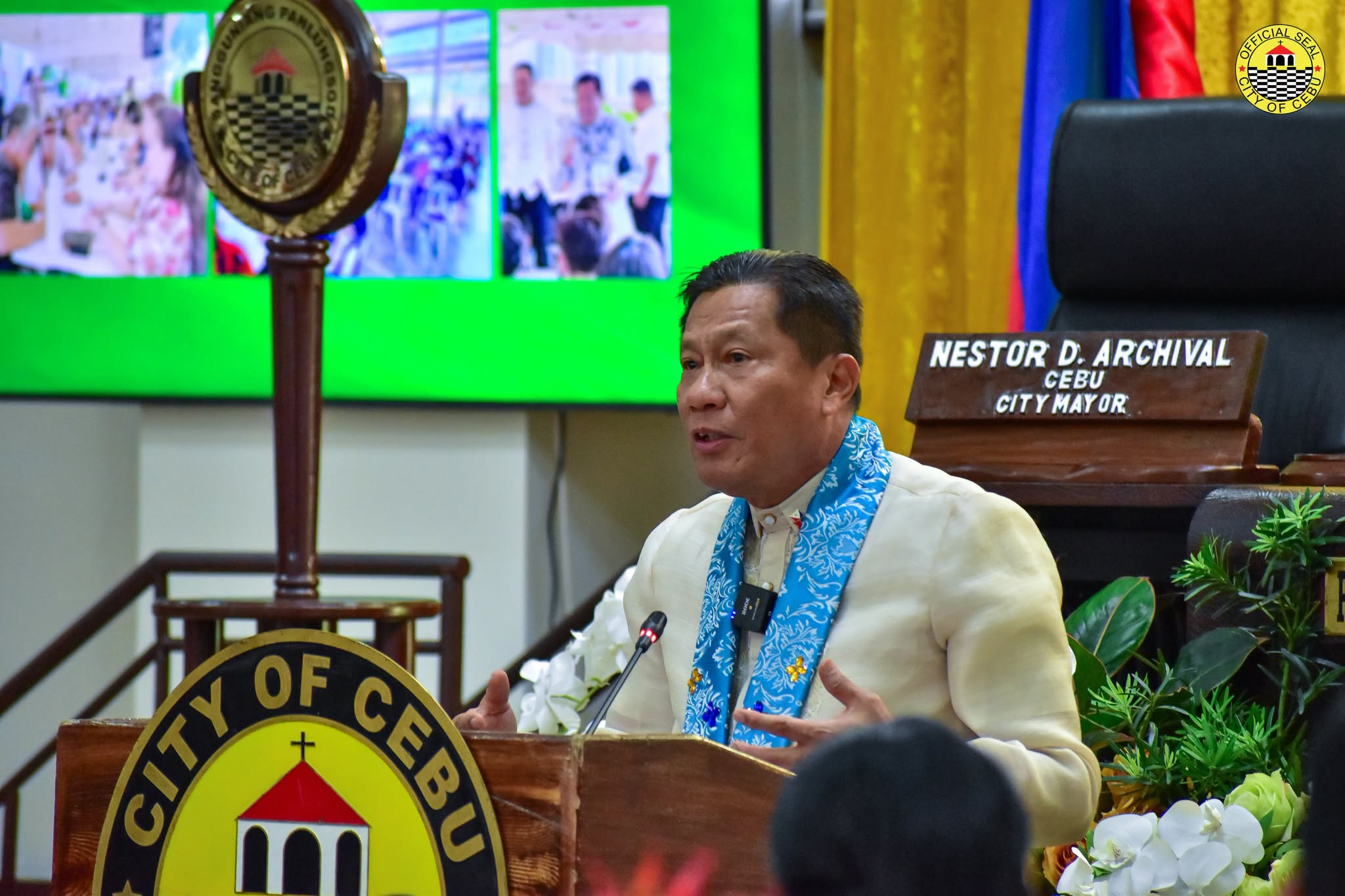
One year after assuming office, Cebu City Mayor Nestor Archival presented a wide-ranging agenda for the city’s future on Tuesday, highlighting his administration’s initial programs while outlining major projects on food security, climate resilience, digital governance, and infrastructure development.
In his first State of the City Address (SOCA), Archival said the foundations established during his first year in office are now being translated into larger programs that will require continued support from the City Council and national government agencies.
The mayor emphasized that implementing the city’s long-term plans would depend on sustained legislative backing and access to national funding.
Among the programs he highlighted was the city’s subsidized rice initiative, which has distributed 20-kilogram sacks of rice to nearly 16,000 low-income families across Cebu City’s north and south districts.
To sustain the program, Archival said the city is working on a partnership with the Department of Agriculture (DA) and Food Terminal Inc. (FTI) to secure a more stable rice supply.
The city has also secured a P145-million allocation from the national government’s Local Government Support Fund, which will be used exclusively to purchase rice for indigent families identified by the Department of Social Welfare and Services (DSWS).
The funding is expected to cover around 180,000 sacks of 10-kilogram rice.
Beyond rice assistance, Archival said the city is seeking more national funding for infrastructure and food security projects.
He said Cebu City has been assured an initial P145 million in infrastructure assistance but could secure more funds if city departments actively submit project proposals.
“If we are active in asking, it will go as high as 1 billion pesos,” Archival told department heads, urging them to speed up the preparation of project proposals.
The city is also seeking between P300 million and P1 billion from the DA for the construction of a modern food terminal.
Archival said the remaining challenge is identifying and acquiring land for the facility, calling on the City Council to help locate a suitable site.
As part of efforts to increase local food production, the city plans to expand its agriculture initiatives through model farms and greenhouse hydroponic systems.
Archival said these facilities will be relocated to the South Road Properties (SRP), with additional demonstration farms planned in the north and south districts starting next year before expanding city-wide by 2028.
The mayor cited the city’s dependence on outside sources for food supply, saying around 65 percent of food consumed in Cebu City comes from outside the island.
“We need food production,” Archival said.
The city’s agricultural push also comes after Typhoon Tino damaged several irrigation facilities. Archival said validation is ongoing, with rehabilitation plans incorporating solar-powered irrigation systems to improve climate resilience.
For long-term water security, Archival said the city is seeking support from the Regional Development Council (RDC) and the Department of Public Works and Highways (DPWH) for P1 billion to fund the study, design, and implementation of the proposed Lusaran Dam project.
Once completed, the project is expected to produce about 100,000 cubic meters of water daily.
Environmental protection also formed part of Archival’s agenda, with the city partnering with the Department of Environment and Natural Resources (DENR) to protect 500 hectares of forestland in Barangay Cantipla.
The city is also proposing to convert a 19-hectare property near Ayala Heights into a public forest park.
Archival reported that 126,000 trees have already been planted out of the city’s three-year target of 256,000 trees, but stressed the need to ensure their survival.
“The challenge is making sure they survive,” he said.
In waste management, Archival highlighted the role of the city’s eco-station at the SRP, which currently diverts 15 tons of garbage daily away from landfills.
He added that planned upland composting facilities are expected to reduce waste by another 20 tons per day.
The city has also reached 90 percent of its target for coastal cleanup efforts in Pasil and is coordinating with the DPWH for the construction of a permanent garbage interceptor to prevent solid waste from reaching coastal waters.
For flood mitigation, Archival said the city will continue dredging and declogging operations while seeking funding for specialized equipment, including an amphibious backhoe for clearing deeper waterways.
On digital governance and traffic management, the mayor announced plans to modernize traffic enforcement through technology.
A feasibility study for a camera-based, no-contact apprehension system is expected to be completed by October, paving the way for budget proposals and supporting ordinances.
The city is targeting procurement in the second half of 2027, with a pilot implementation planned in early 2028.
The system will be complemented by electronic traffic citation devices aimed at digitizing fines, reducing manual processes, and improving traffic enforcement efficiency.















Comments