



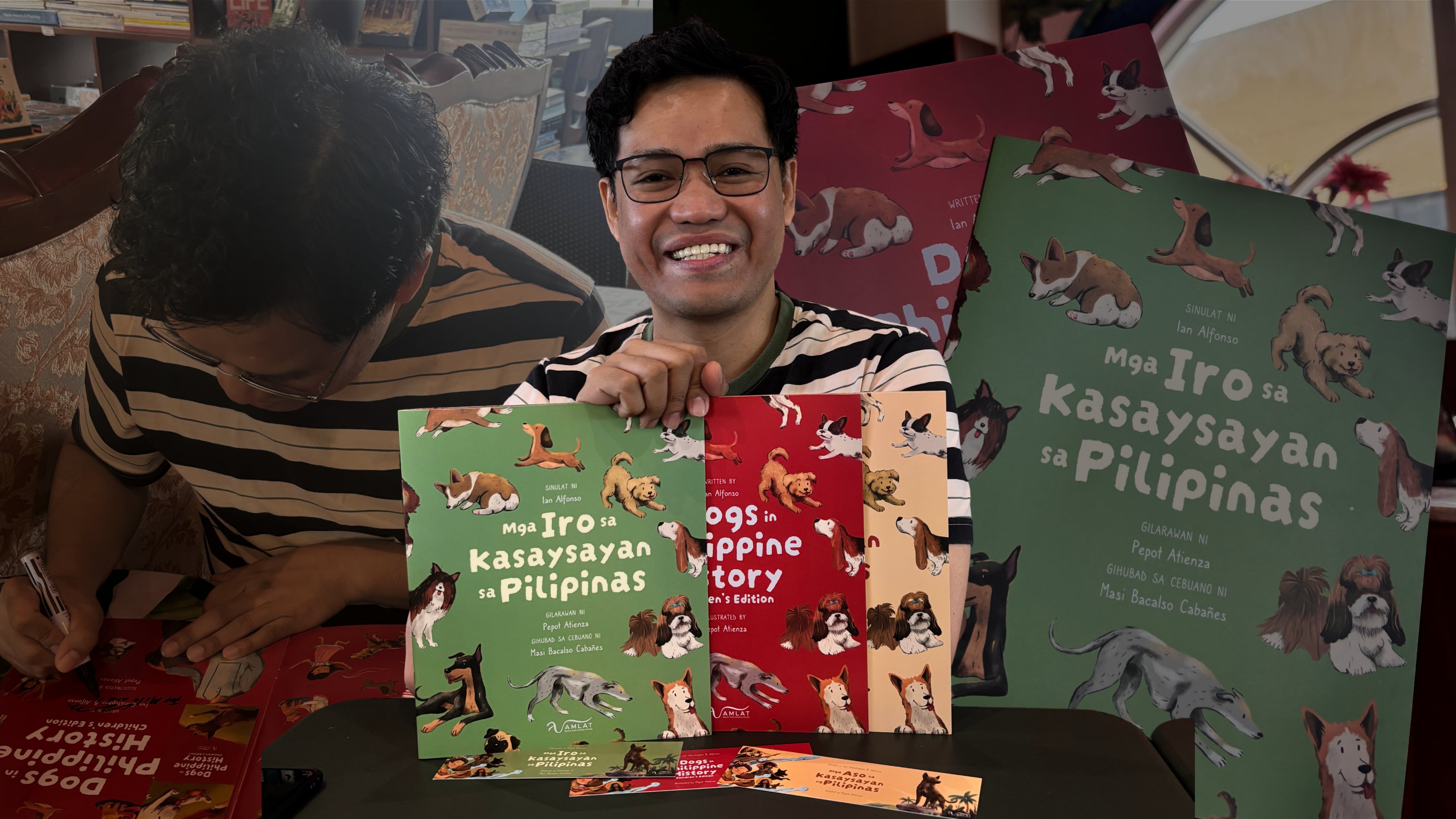
For ten years, historian Ian Christopher B. Alfonso kept his research in a folder of bookmarks on his desktop. Those bookmarks marked the beginning of Dogs in Philippine History, which, on October 19, 2026, became a children’s edition.
Alfonso shared that his interest in animal history began with his love of dogs and cats. Every time he walked into a bookshop, he would find books about dogs from other countries, but none from the Philippines. Filipino literature on dogs does exist. The earliest account he found dated back to 1668 and discussed dogs in the Visayas, followed by another in 1977. Thus, in 2013, he began collecting sources, which, as it turned out, were everywhere. “It was a community effort, of course. People helped in the process,” he said.
From 2013 to 2023, he worked without funding. Two factors eventually led him to produce a version for young readers.
The first was timing. He waited for a study by the UP School of Archaeology, where researchers were examining the genetics of ancient dogs unearthed across the country. The study is expected to conclude around 2027 or 2028. Rather than reprinting the original edition while waiting for its findings, he decided to produce a children’s edition.
“We still don’t know empirically if the aspin descended from these ancient dogs we had,” he said.
The second was inspiration. He credited notable children’s author Dr. Eugene Y. Evasco for encouraging him to write about dogs for children. Around December 2024, Alfonso wrote a short essay on dogs in Philippine history, with the book initially scheduled for publication the following year. However, when the publisher encountered internal problems, he convinced his younger brother, who owns a publishing house, to take on all three versions of the book: English, Cebuano and Filipino.
For Alfonso, the audience matters as much as the content. “I believe we need to invest in children,” he said. “Every day, we encounter animal abuse, whether it be a cat or dog. These occurrences are not done by the children themselves, but by the adults who are expected to know what’s right and wrong. As my contribution to the children’s book industry, [I want to] educate the children about animal welfare.”
That concern also shaped how he tells the story of the aspin. The earliest domesticated dog found in the Philippines is nearly 4,000 years old. Whether it is genetically related to today’s aspins has yet to be proven. However, Alfonso believes aspins were here long before the term even existed.
In the old Visayas, they were called iro and were pampered, Alfonso noted.
“They had a very important role in society because they had hunting abilities. They were accustomed to the terrain, scents and other characteristics of the Philippines,” he shared.
He recalled how they were treated: “May kumot, hinahalikan.” (They had blankets, they were kissed.) Alfonso then asked, “Bakit naging kawawa… pinabayaan ang mga aspin?” (Why did aspins become pitiful and neglected?)
Alfonso hopes for better treatment of aspins in society, just as they were treated a thousand years ago. Getting that message across was the hardest part of the project. The challenge was to condense it into something concise and well-curated, and to decide “anong narrative ang dapat maipatawid sa mga bata” (“what narrative should be passed on to the children”).
Somewhere, the answer to his biggest question is still being traced through the genes of ancient dogs: Did aspins walk beside the first people of these islands? Until that question is answered, Alfonso has done what he can.
A folder of bookmarks became a book, and that book is now in the hands of children. They may grow up knowing that the dogs beside them have a history thousands of years long, and that it began with someone who loved them enough to keep looking.















Comments