



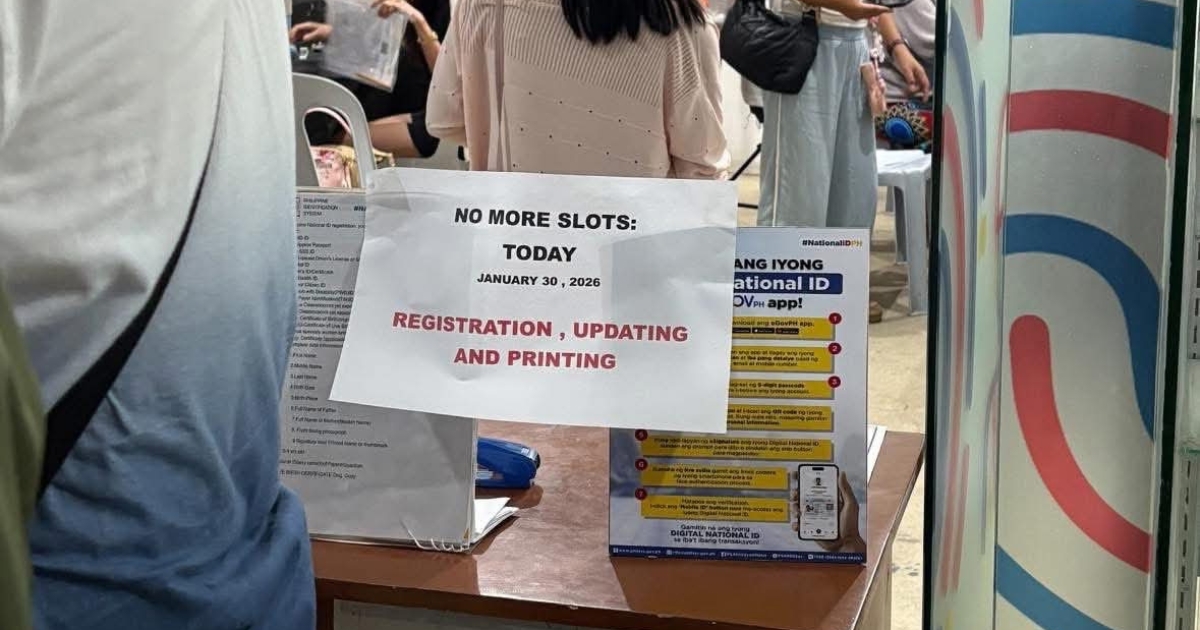
Jay (not her real name) believed her first attempt failed because she arrived too late. She had gone to one of the PhilSys Registration Centers at 2 PM on a Thursday, only to find no slots left. Determined to succeed, she adjusted her schedule for a second try.
“I work a graveyard shift, so waking up early is already a big sacrifice,” Jay said. She arrived at 11 AM on Friday, January 30, confident that this was early enough to secure a spot.
What she found was not an orderly system, but confusion. Seniors and parents milled around an unmanned information desk. After waiting in an improvised line, a staff member finally approached. That’s when Jay received the same disheartening news: the center had already reached its daily limit, just 15 slots for a day. She was told to simply come back earlier the following Monday.
“There was no alternative offered, no system explained, nothing,” Jay recalled.
A Bottleneck of Bureaucracy The Philippine Identification System (PhilSys), a cornerstone of the government’s digital identification rollout, faces a sharp operational bottleneck in Cebu.
For Jay, who pays over ₱30,000 in taxes each year, the experience felt unjust. “I refuse to accept this kind of service,” she said. “We pay for these services, so the least we should expect is a system that actually works.”
She clarified that the staff were not rude; they were polite, but powerless. The problem was systemic, not personal.
The Human Cost of ‘System’ Failure Jay’s story resonates with a widespread frustration over bureaucratic delays. Her experience highlights a persistent gap between national policy and on-the-ground execution, where citizens pay the price in time, lost wages, and mounting frustration.
“It just felt really unfair,” she said. “Not just for me, but for everyone who took time off, lined up, and waited.”
A Call for Practical Solutions When asked how to fix the problem, Jay focused on basic logistics. “Have multiple windows for different concerns… Improve the equipment so staff can work faster,” she suggested. “Right now, everything is bottlenecked into one slow process, and the public ends up paying for it with time and frustration.”
Her recommendations call for a need for simple process improvements: dedicated queues, updated technology, and clear public communication, steps that seem fundamental for a program of PhilSys’s scale.
PSA’s Response Awaited As of this writing, the Philippine Statistics Authority (PSA) Region VII has not commented on this matter. The public remains in the dark over whether the 15-person limit is a temporary measure or the program’s standing pace.
For Jay, a third attempt to apply for her national ID will mean taking another half-day off work and another personal cost added to a process meant to be a public service.















Comments