
A commute measured in minutes instead of hours — that is the future transport planners are mapping out for Metro Cebu as the government rolls out a slate of rail, road, sea, and air projects meant to change how people move across the region.
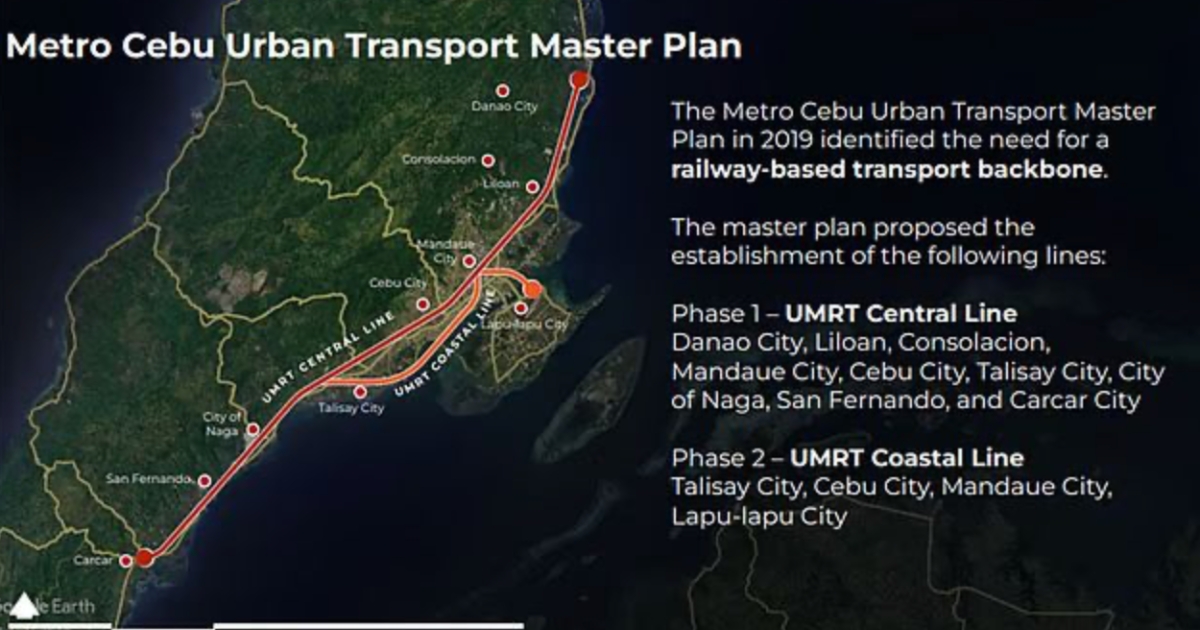
The Department of Transportation (DOTr) is advancing plans for a P199-billion coastal railway connecting Danao City to Carcar City, anchored on the 67.5-kilometer Metro Cebu Urban Mass Rapid Transit system and a 25-kilometer line to Mactan-Cebu International Airport.
Transportation Secretary Giovanni Lopez said the agency is prioritizing projects that will help commuters and drive economic growth, following a directive to accelerate transport infrastructure beyond Metro Manila.
“Hopefully we can start the feasibility study by October 2026,” Lopez said, adding that once done, “we will start coordinating with the local government.”
The government expects to begin procurement for the feasibility study by March 2026 and aims to complete at least the feasibility phase before the end of the administration in 2028, with the railway targeted for completion by 2040.
While the rail project is being prepared, Package 1 of the Cebu Bus Rapid Transit system is set to open by March 2026, covering three stations — the Cebu South Bus Terminal Station, Cebu Normal University Station and Fuente Station.
“When Package 1 becomes operational, 34,000 passengers daily will benefit. So the benefits of BRT for Cebu will be huge,” Lopez said.
The DOTr has also built 189 kilometers of bike lanes in Metro Cebu, with a P498-million project set to add 13 more kilometers and 26 public utility vehicle stops.
Port developments are also underway, including the New Cebu International Container Port in Consolacion, which is more than 20 percent complete and is expected to ease congestion at the Cebu City baseport.
The San Fernando Port is scheduled for completion this year, with roll-on, roll-off ramps and weighbridges to prevent truck overloading.
In aviation, public-private partnerships have expanded passenger capacity at the Mactan-Cebu International Airport from 7.5 million to 14 million annually, while a runway rehabilitation project set for completion in the second quarter will strengthen pavement and improve safety during adverse weather.
Improvements at Bohol-Panglao International Airport have nearly doubled capacity.
“The Department of Transportation is not just for Metro Manila — equally important is how to connect those in the provinces and regions,” Lopez said.
Officials said the combined projects aim to ease congestion, improve connectivity, and support Cebu’s role as a growing economic and logistics hub.

Comments