



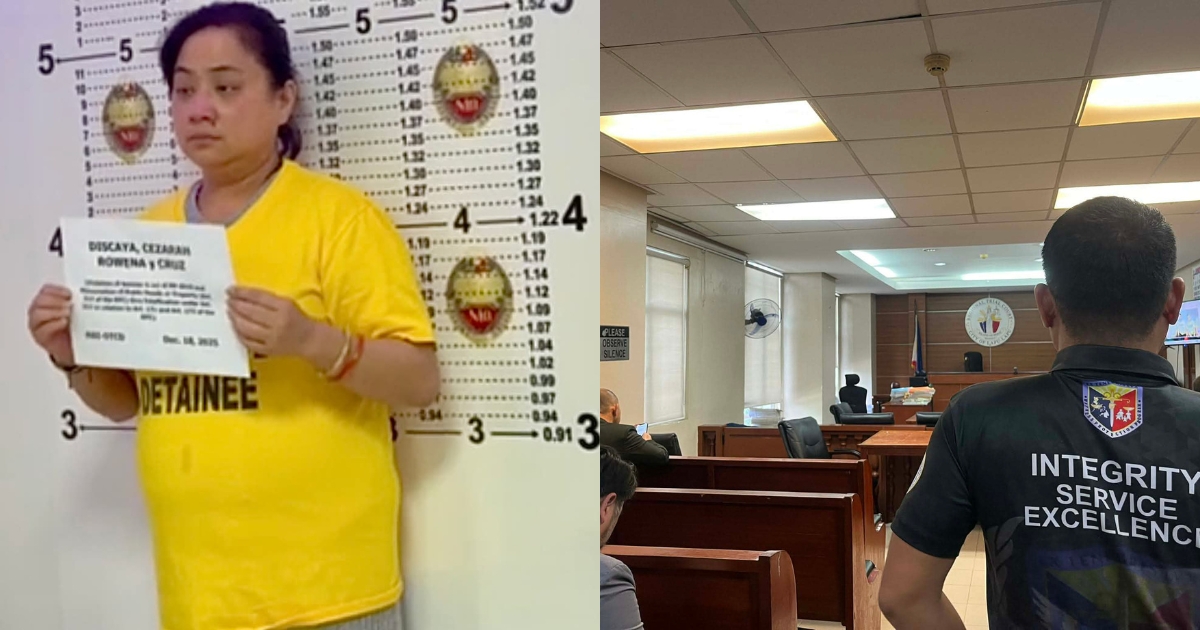
Contractor Sarah Discaya, St. Timothy Construction president Maria Roma Rimando, and eight officials of the Department of Public Works and Highways (DPWH) Davao Occidental District Engineering Office appeared for their pre-trial hearing before Regional Trial Court Branch 27 in Lapu-Lapu City on February 27, 2026.
The accused DPWH officials are Rodrigo Larete, Michael Awa, Joel Lumogdang, Harold John Villaver, Jafael Faunillian, Josephine Valdez, Ranulfo Flores, and Czar Ryan Ubungen.
They are charged with violation of Section 3(e) of Republic Act No. 3019, or the Anti-Graft and Corrupt Practices Act, as well as malversation of public funds through falsification of commercial documents, in connection with the alleged P96.5-million “ghost” flood control project in Davao Occidental.
The accused attended the hearing via online conferencing from the Bureau of Jail Management and Penology (BJMP) facility in Lapu-Lapu City, while their respective legal counsels personally appeared before the court.
The nearly three-hour pre-trial hearing before Judge Nelson Leyco focused on proposed stipulations of facts between the prosecution, represented by the Office of the Ombudsman, and the defense.
During the proceedings, the prosecution presented at least 54 proposed stipulations. The defense largely denied these, admitting only some that were based on common documentary exhibits.
Ombudsman Officer-in-Charge for Preliminary Investigation Jess Vincent A. Dela Peña presented stipulations identifying the signatories and documents related to the two-kilometer revetment project in Barangay Kulaman, Jose Abad Santos, Davao Occidental.
One proposed stipulation alleged that Rimando, Discaya, and Discaya’s husband, Curlee Discaya, are stakeholders in three construction firms — St. Timothy Construction, St. Gerard Construction, and Alpha & Omega General Contractor & Development Corp.
However, Discaya’s counsel, Atty. Angela Marie Almabis, denied the stipulation, saying she had no knowledge of Discaya’s involvement in St. Timothy and St. Gerard, and maintained that Discaya is connected only to Alpha & Omega General Contractor & Development Corp.
Other proposed stipulations tackled whether the three firms shared the same email address, business address, contact numbers, financial statements, and articles of incorporation.
Almabis denied all these stipulations, while Rimando’s counsel, Atty. Cornelio Samaniego, admitted them only insofar as they pertain to St. Timothy Construction.
Dela Peña also raised the issue of Rimando’s familial relationship with the Discaya couple. Rimando admitted during the pre-trial that she is their niece.
The prosecution further stipulated that St. Timothy Construction emerged as the lowest bidder for the project, while Alpha & Omega General Contractor & Development Corp. was the second lowest bidder. Samaniego admitted this, confirming that St. Timothy was awarded the contract.
The prosecution also alleged that Rimando served merely as a “dummy” of the Discaya couple, a claim the defense categorically denied.
In a separate interview, Atty. Paul Tristan Sato, counsel for the DPWH officials, said the alleged “ghost project” actually exists.
This was echoed by Atty. Joseph Randi Torregosa, counsel for Larete, who said the defense would, in due time, move for an ocular inspection “to settle the issue once and for all.”
Torregosa explained that the defense denied most of the stipulations because these referred to documents allegedly not furnished to them by the prosecution.
“Most of the stipulations we denied involve other corporations allegedly owned by Mrs. Discaya. The prosecution is trying to link her to St. Timothy Construction,” Torregosa said.
He added that since his client has no involvement with these other corporations, the stipulations are irrelevant to Larete’s case.
Sato shared the same position, noting that several documents were denied admission because the defense had not been given sufficient opportunity to examine them with their clients, the DPWH officials.
The defense also emphasized that while their clients admitted being public officers, all elements of malversation must still be proven beyond reasonable doubt.
While the court noted that the element of being a public officer has already been admitted, the prosecution must still establish through evidence the remaining elements of the offense — namely, that the accused had custody or control of public funds, that the funds involved were public in nature, and that there was misappropriation, conversion, or loss of the funds — as the trial proceeds.
The pre-trial remains ongoing, with Judge Leyco setting its continuation on March 10.(VCL)















Comments