
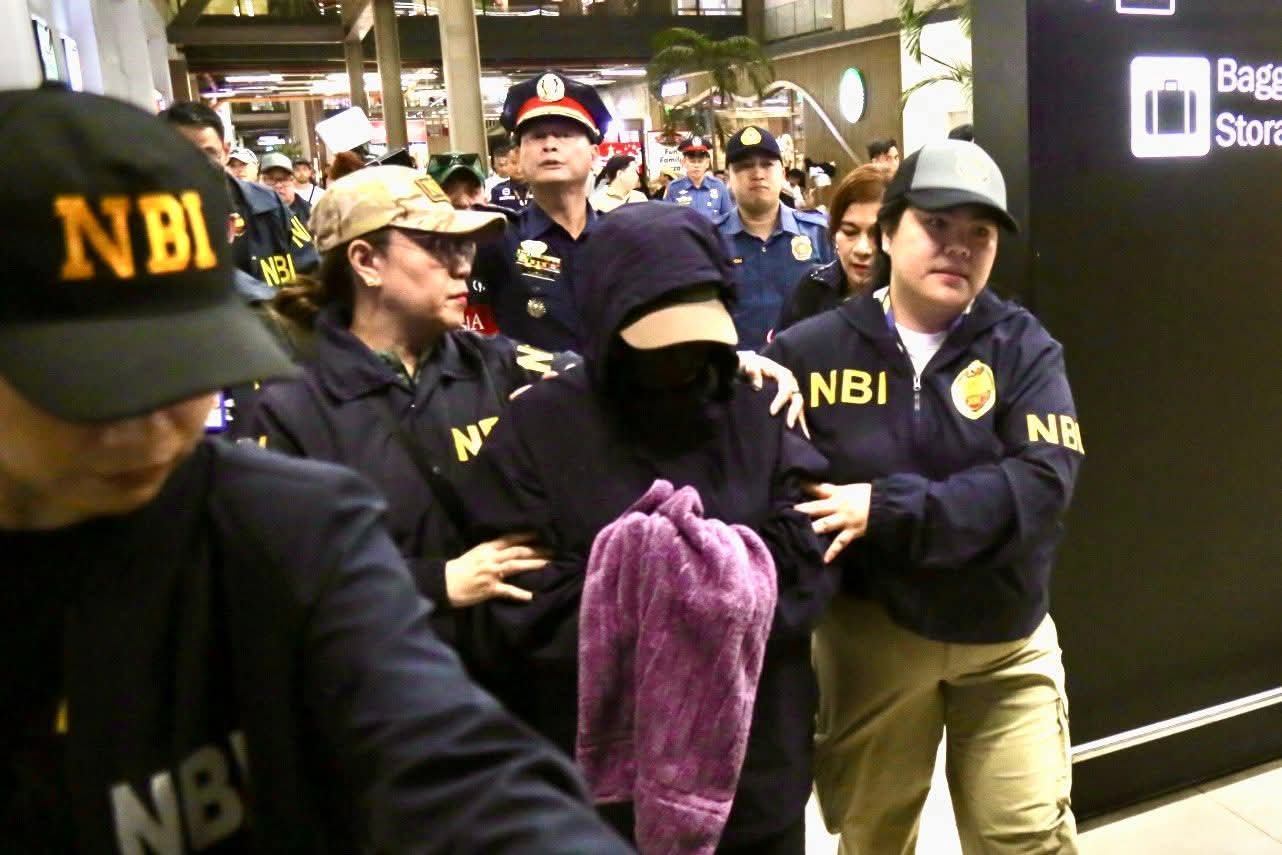
The defense of contractor Sarah Discaya, St. Timothy Construction Corp. president Maria Roma Rimando, and eight officials from the Department of Public Works and Highways (DPWH) Davao Occidental District Engineering Office maintained that the P96.5-million flood control project in Barangay Kulaman, Jose Abad Santos, is not a “ghost project,” during the trial held on April 7, 2026.
The accused DPWH officials — Rodrigo Larete, Michael Awa, Joel Lumogdang, Harold John Villaver, Jafael Faunillian, Josephine Valdez, Ranulfo Flores, and Czar Ryan Ubungen — face graft charges under Republic Act No. 3019 and malversation of public funds through falsification of commercial documents.
Prosecution witnesses from the Office of the Ombudsman, acting through the Quality Assurance Unit (QAU), testified that the project deviated from the approved Detailed Engineering Design (DED) and other official documents.
They said the partially completed structure, a 2-kilometer revetment, did not match the coordinates specified in the plans and cited discrepancies in stone sizes and rebar splicing.
The witnesses said they conducted a technical inspection on October 25, 2025, and observed that the starting point of the riverbank project was approximately 400 meters from the coordinates in the approved plans.
During cross-examination, defense counsel Atty. Joseph Randi Torregosa highlighted that the project was visibly under construction during the Ombudsman’s inspection, with ongoing works and portions of the riverbank already completed.
“The theory of the prosecution is that the project is a ghost project…yet the witness admitted that it is not a ghost project because when he personally inspected the site, there was a portion of the riverbank partially completed, and there were ongoing works,” Torregosa said.
Torregosa and co-counsel Atty. Cornelio Samaniego for Rimando argued that the project physically exists and underwent repairs after typhoon and heavy rain damage in December 2024, further confirming that it is not a ghost structure.
They also noted that portions of the flood control project had already been built by the time of the Ombudsman’s inspection.
The flood control project, which ran from January 13, 2022, to November 14, 2023, aimed to protect communities along the Kulaman riverbank.
Defense lawyers emphasized that while some portions remained incomplete during inspections, this does not constitute a ghost project.
The trial continues as both sides present technical assessments, inspections, and documentation to support their respective positions on the flood control project’s legitimacy and completion status. (VCL)

Comments