



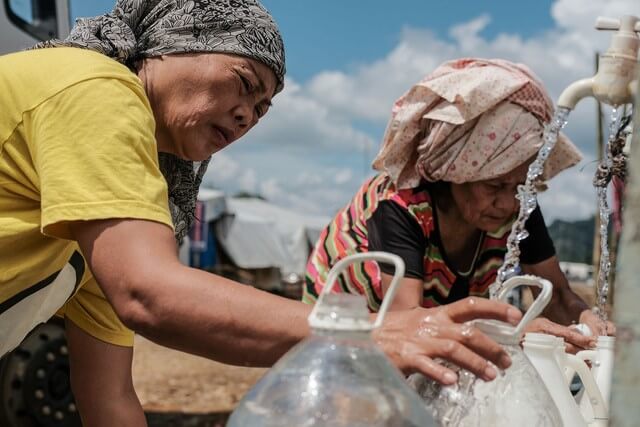
Cebu is drawing only about half of the water it needs each day, forcing officials to accelerate supply projects as El Niño conditions threaten to deepen shortages across the province.
Provincial data shows daily demand at around 350 million liters per day (MLD), while existing systems are delivering only roughly 50 percent of that requirement.
Engr. Aldrin Barade, head of the Cebu Provincial Inter-LGU Waterworks Office, said the province is moving to fast-track bulk water developments to close the widening gap.
He noted that several local government units are already experiencing shortages as consumption continues to outpace available sources in some areas.
To address immediate needs, the province has deployed water trucking operations as a stopgap measure for affected communities.
Barade said emergency supply is currently being sourced from existing bulk water facilities in Moalboal and Carmen, which serve nearby areas including Moalboal and Carcar.
These facilities produce a combined output of about 4.8 MLD, which remains far below overall demand.
Expansion efforts are underway, with projections targeting a rise in capacity to about 33 MLD by the end of 2026.
Under the plan, Moalboal’s output is expected to increase from 3 MLD to 6 MLD, while Carmen’s capacity will rise from 1.8 MLD to 3 MLD.
Additional bulk water projects are also being developed in Barili, Oslob, San Fernando, Malabuyoc, Alegria, Tabogon, and Boljoon, which are projected to add around 28.20 MLD once completed.
Barade said the long-term strategy includes strengthening distribution systems through interconnected water networks across LGUs.
The province is also shifting toward surface water sources such as rivers, which officials consider more sustainable than reliance on springs.
He, however, pointed out that surface water development requires heavy investment, particularly for treatment facilities and supporting infrastructure such as pipelines and pumping systems.
Barade acknowledged that Cebu still lacks a comprehensive water data system, which he said is necessary for accurate planning and resource allocation.
The provincial office is currently working on improving data collection and analysis as part of its planning reforms.
A 10-year clustering strategy is also being prepared, aimed at integrating water systems across multiple LGUs to improve efficiency and distribution.
Under the plan, grouped LGUs will share infrastructure to maximize supply and reduce redundancy, with a projected provincial contribution of around 32 MLD over the long term.
The provincial government said its bulk water projects are intended to supplement existing water district and LGU systems, not replace them.
Governor Pamela Baricuatro has also pushed for the construction of dams as a long-term solution to both water shortages and flood control concerns.
She said such infrastructure could have helped cushion the impact of recurring dry spells like El Niño.
The Department of Public Works and Highways in Central Visayas has proposed seven dam sites across Cebu, including river systems in Mananga, Bulacao, Guadalupe, Butuanon, Lusaran, Cotcot in Liloan, and areas in Danao City.
The provincial government is likewise exploring partnerships with an Israeli-based firm and the University of San Carlos for water technology solutions, including mobile treatment systems and improved distribution methods.
Initial rollout of new systems is expected to prioritize barangays with high demand and limited access to potable water. (SBA)















Comments