



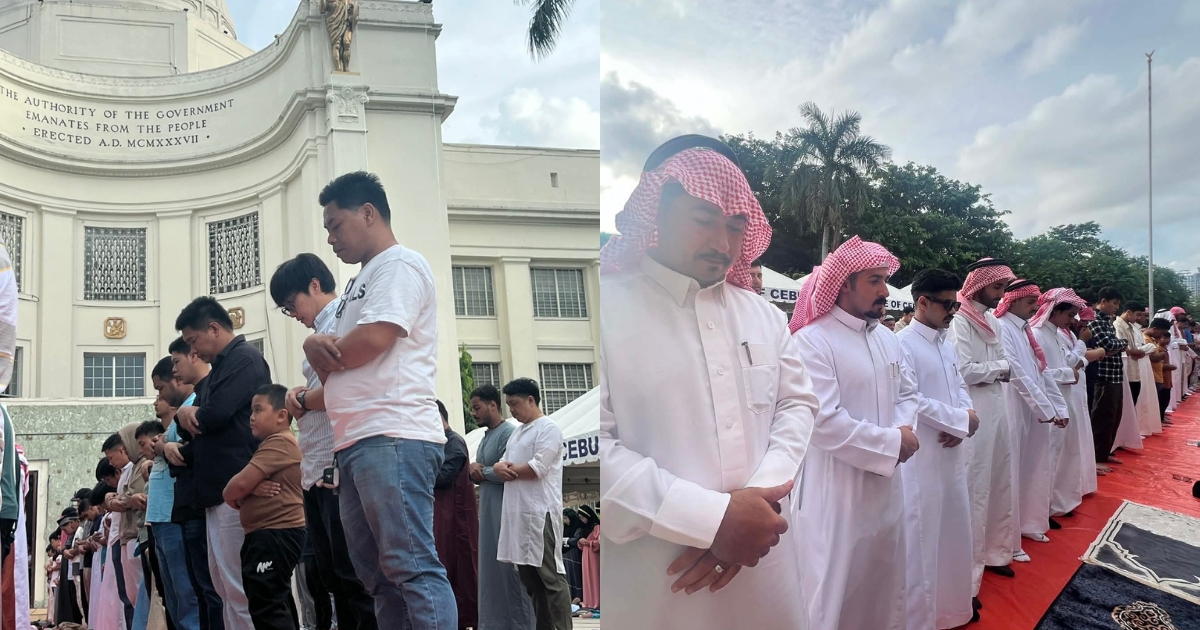
Hundreds of Muslims from across Cebu gathered at the Cebu Provincial Capitol on Wednesday, May 27, for congregational prayers and fellowship during Eid al-Adha, marking the first time the provincial government formally opened its grounds for the religious observance.
Beyond the celebration, the gathering also surfaced long-standing concerns within the Muslim community, including limited access to government services, cultural misunderstandings, and the absence of a centralized office to address their needs.
Arlene Sanoh-Salahuddin, consultant and spokesperson of the Salaam Police Advocacy Group in Central Visayas, said the event represents a meaningful step toward recognition and inclusion.
“This is very significant because this is the first time in the past 500 years that the Capitol opened the gates for the congregation of the Muslim community to pray for Eid’l Adha,” she said.
Sanoh-Salahuddin said many Muslims in Cebu have long felt overlooked despite the growing size of their community in the province, noting that the gathering also served as an opportunity to promote peaceful coexistence and stronger community ties.
“With that, we wanted the entire Cebu Province to see that the Muslim communities are friends and can get along even with non-Muslims. God-willing this will be the start,” she said.
She added that while the Muslim population in Cebu continues to expand, some still hesitate to openly practice traditions due to concerns over discrimination or misunderstanding.
“If you notice, ang mga Muslim nakagawas-gawas na sila karon, nagkadaghan-daghan na since di na kaayo sila murag mahadlok going out in the open,” she said.
An estimated 500 to 600 participants attended the Capitol gathering, with Muslim communities coming from Danao City, Toledo City, Talisay City, and nearby areas.
The event also became a venue for discussions on proposed institutional support, including plans to establish a dedicated Muslim Affairs office in Cebu Province to centralize assistance for documentation, coordination with agencies, and community concerns.
“What the Cebu Capitol would want is that at least naay ta centralized help even if we start with a very small staffing only so as long as we are able to start it,” Sanoh-Salahuddin said.
She also raised concerns about challenges faced by Muslim families in hospitals, particularly in observing burial practices that require immediate interment without embalming.
“Sauna kinahanglan pa gyud moagi sa punerarya and everything. So karon, we’re actually making sure nga kami na jud ang mopull out para di na sad hasul sa mga kuan nato sa DOH,” she said.
Sanoh-Salahuddin added that Muslim communities in Cebu have also contributed during major crises, including Typhoon Odette, earthquakes, and the COVID-19 pandemic, but still feel underrepresented in public policy discussions.
During the event, five-kilogram sacks of rice were distributed through a partnership between the Cebu Provincial Government and the Cebu Provincial Police Office as part of the Eid celebration.
Governor Pamela Baricuatro, who was not physically present, delivered a recorded message highlighting the importance of unity amid diversity.
“As governor, I have always believed that one Cebu’s greatest strength is our diversity. Different cultures, beliefs, and traditions coming together with mutual respect and understanding makes our province stronger and more beautiful,” she said.
Photos courtesy of Kaiser Jan Fuentes















Comments