



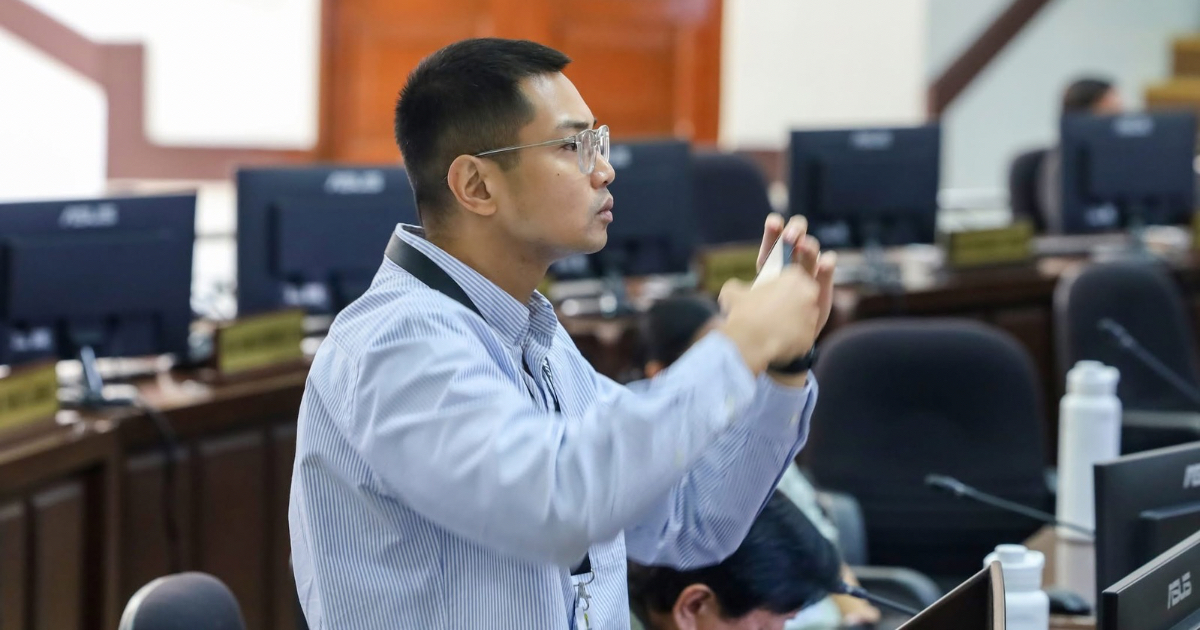
Cebu City Councilor Mikel Rama has questioned the legal position taken by the Integrated Bar of the Philippines (IBP) on the Senate quorum dispute, arguing that reducing the chamber’s effective membership undermines the mandate given by millions of Filipino voters.
In a statement issued Friday, June 5, Rama, a lawyer and IBP member, said he disagrees with the IBP Board of Governors’ interpretation supporting a reduced Senate quorum amid the ongoing controversy surrounding the Senate’s leadership reorganization.
“As a member of the IBP, I respectfully disagree with the Board of Governors’ recent legal interpretation supporting a reduced Senate quorum of 22 members,” Rama said.
The debate stems from conflicting views on how a quorum should be computed in the 24-member Senate following the leadership changes that took place earlier this week.
Rama argued that Senate seats represent the electorate rather than the individual officeholders who occupy them.
“A Senate seat and the legislative vote it carries does not belong to the sitting senator. It belongs to the electorate,” he said.
Citing provisions of the 1987 Constitution, Rama stressed that sovereignty resides in the people and that public office is a public trust.
He maintained that reducing the Senate’s working membership to justify a lower quorum requirement effectively weakens voter representation.
“Artificially shrinking the Senate’s working base to manufacture a 12-vote majority does not only sideline two politicians; it disenfranchises millions of voters,” he said.
Rama added that institutional stability should be anchored on respecting the full outcome of elections rather than on procedural interpretations that alter the numerical basis for Senate voting.
“Institutional stability relies on respecting the full electoral outcome, not using procedural shortcuts to alter the chamber’s math,” he said.
He also called on legal practitioners to consider democratic principles and voter sovereignty when interpreting parliamentary rules.
“A resilient institution should not use legal gray areas to silence an electoral mandate but rather it should seek every means to preserve it,” Rama said. “Parliamentary rules exist to protect the people’s voice, not to justify exclusion.”
The statement came a day after supporters of former President Rodrigo Duterte held a rally at Plaza Independencia in Cebu City, where participants questioned the legitimacy of the Senate’s recent leadership reorganization and echoed claims that the election of a Senate president requires at least 13 votes from the chamber’s 24 members.
The IBP, however, has defended the legality of the June 3 Senate session. In an earlier statement, the organization cited the Supreme Court ruling in Avelino v. Cuenco, arguing that a quorum may be determined based on senators whose attendance can be compelled by the Senate.
Under that interpretation, the IBP said 12 senators constituted a valid quorum after excluding members who could not realistically be compelled to attend the session.
Former Senate president Franklin Drilon has likewise maintained that the Senate reorganization remains valid unless overturned by the Supreme Court.
Several senators, including Loren Legarda and Pia Cayetano, have taken the opposite position, arguing that the Constitution requires 13 votes to elect a Senate president because the chamber has a full membership of 24.
While not directly addressing the legal precedents cited by the IBP, Rama emphasized that legal interpretations should not diminish the representation granted by voters through elections.
“As legal practitioners, we must safeguard the stability of our democratic institutions and the sovereign will of the voters, rather than validate interpretations that diminish them,” he said.
The dispute over quorum computation and the validity of recent Senate actions continues to draw debate among lawmakers, legal experts, and political groups.
Photo courtesy of Sangguniang Panglungsod Cebu City - Secretariat















Comments