



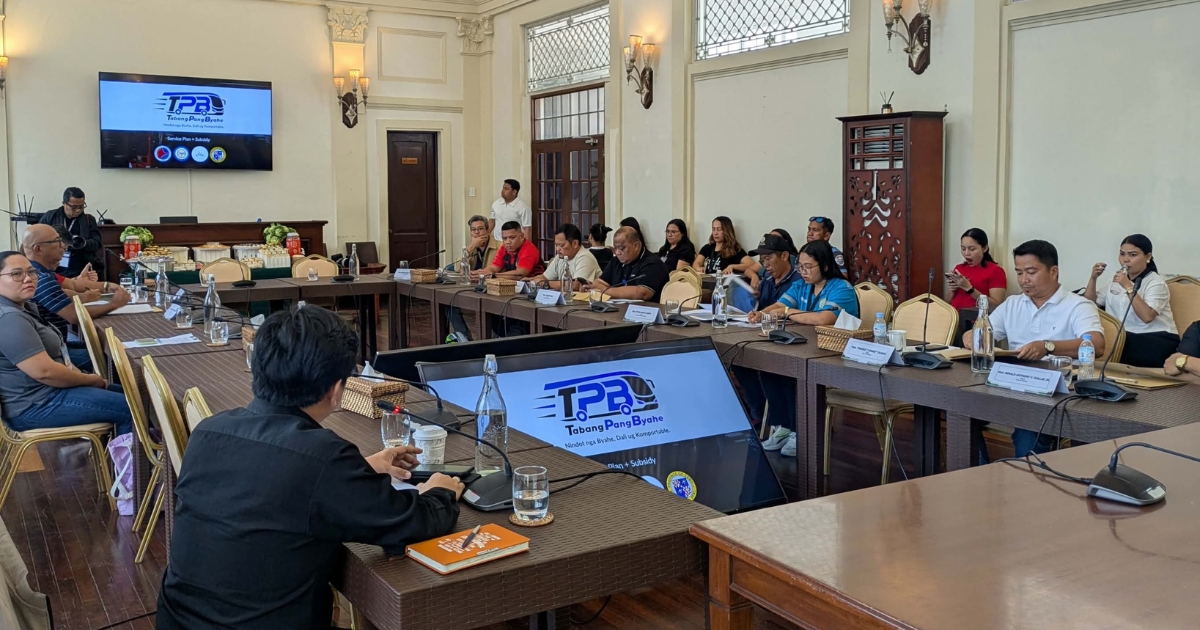
The Cebu Provincial Government is moving closer to rolling out its Tabang Pangbyahe Program after completing the consolidation of designated bus stops across key cities and municipalities, a major preparatory step for the planned public transport reform.
The initiative, which may be launched as early as July, is part of the province’s push toward a more structured and performance-based public transport system aimed at improving commuter reliability, safety, and convenience.
The program is now awaiting the signing of a memorandum of agreement (MOA) with the Department of Transportation (DOTr), which will formally trigger implementation.
Local government units across Cebu have already agreed on fixed boarding and drop-off points to standardize routes and help reduce roadside congestion once the system becomes operational.
Under the finalized bus stop allocation, Cebu City will have 22 stops, Mandaue City 25, Consolacion 12, Liloan 28, Compostela 16, and Danao City 29.
In southern Cebu, Talisay City has been assigned 10 stops, Minglanilla 8, Naga City 16, San Fernando 20, Carcar City 26, and Sibonga 18, completing the province-wide network design.
Elizar Sabinay, Executive Assistant V of the Provincial Planning and Development Office and Investment Promotions, said the program could begin “this month or early July,” depending on the completion of documentary requirements and the MOA signing.
He said the consolidation of bus stops is a key step in ensuring uniformity across routes, particularly in high-traffic urban and inter-municipal corridors.
Sabinay described the initiative as a pioneering local transport reform, noting that it is the province’s first government-led, funded, and operated service contracting program.
“The project is the first local government-led, funded, and operated service contracting program for reliable and quality public transport services,” he said.
Unlike traditional transport systems, the program will adopt a service contracting model where operators are paid based on performance standards rather than passenger volume.
Sabinay said operators must comply with provincial requirements to qualify for government subsidies, ensuring accountability and service efficiency.
“If it is set by the province, they need to follow a certain requirement from the province for them to get a subsidy,” he said.
Subsidies will be computed per kilometer traveled, estimated at P54 to P60 per kilometer depending on final evaluation and operational performance.
The system is designed to replace the boundary-based arrangement commonly used in public transport, shifting toward a commuter-centered model focused on predictable travel times and improved service regularity.
Once implemented, buses will be required to strictly follow designated stops, observe a maximum one-minute dwell time per stop, and prohibit standing passengers during peak hours to improve safety and efficiency.
Sabinay said one of the program’s key goals is to reduce passenger waiting times, which currently reach 15 to 20 minutes during peak hours in some routes.
With the new scheduling system, buses are expected to arrive at intervals of 15 to 20 minutes, improving predictability for daily commuters.
The provincial government said the initiative is not a free transport scheme but a subsidized system aimed at improving overall service quality and commuter experience.
To support planning and monitoring, the program will incorporate an artificial intelligence-based mobility tracking system under the Department of Science and Technology’s Balik Scientist Program to analyze traffic flow, passenger demand, and route efficiency.
Once the MOA is signed, implementation will proceed immediately, with initial funding support of P20 million from the DOTr allocated for the pilot phase of what is expected to be Cebu’s first large-scale provincial transport reform.
Photo by SBA















Comments