



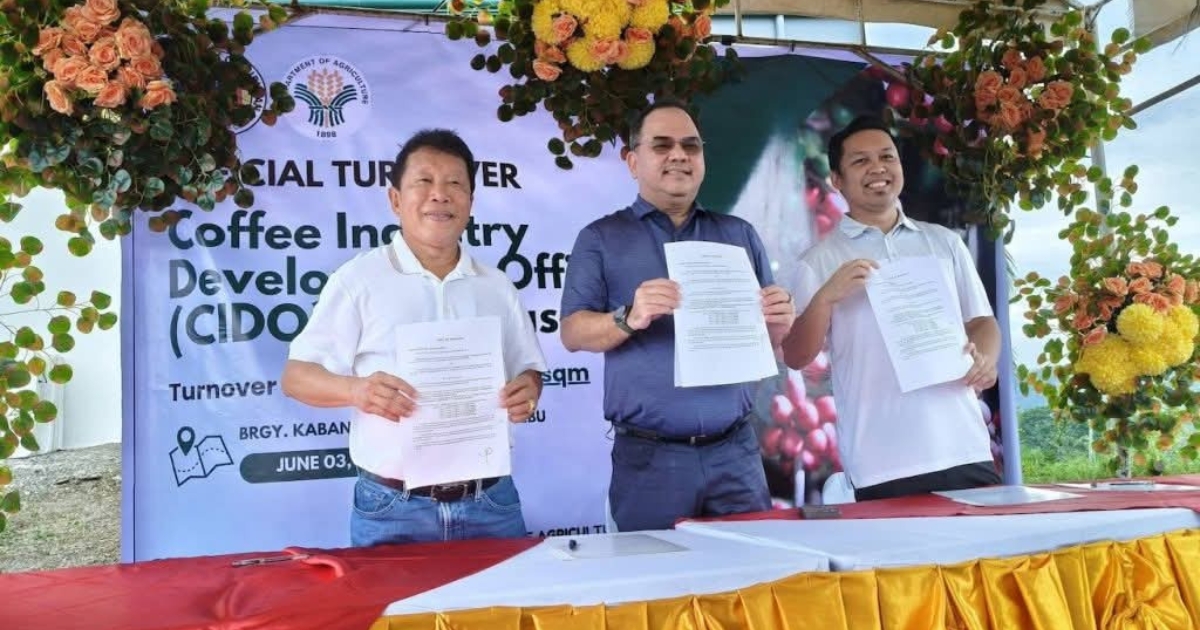
A former mayor’s land donation has paved the way for the establishment of the first Coffee Industry Development Office (CIDO) in the Visayas, which will be located in Barangay Kabangkalan, Tuburan, Cebu, marking a major push to expand coffee production in the region.
The Department of Agriculture (DA) is set to build the CIDO-Visayas on a one-hectare lot donated by former Tuburan mayor Democrito “Aljun” Diamante, founder of Tuburan Coffee, during a turnover ceremony on June 3.
The new office is envisioned as a regional hub for research and development, training, innovation, and technology transfer to support coffee farmers in Tuburan and nearby provinces across the Visayas.
Agriculture Undersecretary for Special Concerns and official development assistance Jerome V. Oliveros said the initiative comes at a time when the Philippines remains heavily dependent on imported coffee.
“The order is to plant 100,000 hectares of coffee within the next three years or until 2028,” Oliveros said, noting the need to expand local production to meet demand.
He said the establishment of CIDO-Visayas would position Tuburan at the center of what he described as a “coffee revolution” in the region.
The DA also plans to establish a nursery within the site for high-quality coffee varieties, including robusta and arabica, to support farmers in scaling up production.
Diamante said Tuburan currently has nearly 2,000 coffee farmers and that its mountainous terrain is well-suited for arabica cultivation.
The town already has 336 hectares planted with coffee, though its 54 barangays still have vast areas available for expansion.
Based on municipal agriculture data presented during a Coffee Technical Working Group meeting, Tuburan produced 108 metric tons of coffee in 2025.
The assessment also identified 7 barangays with 4,561.54 hectares suitable for coffee farming and another 13 barangays with 16,047.30 hectares with potential for expansion.
Diamante said Tuburan has the capacity to lead coffee development not only in Cebu but across the Visayas, citing the country’s reliance on imports.
“We are importing our coffee, mainly from Vietnam and Indonesia. Our annual demand is between 150,000 and 200,000 metric tons, while our local production is only about 30,000 to 33,000 metric tons, which we mainly source from Mindanao,” he said.
He urged farmers to maximize idle lands for coffee production, adding that government support would help scale up the industry.
“Do not worry, the government is here to help us,” Diamante said, noting that farmers will be provided with quality seeds, farm access roads, and water support.
He also relayed assurances from the DA that infrastructure and production assistance would be rolled out to strengthen the sector.
“Usec. Oliveros promised to provide you quality seeds, access roads to your farms, and accessible, adequate water,” he added.
Local farmers welcomed the development, with Evelyn Bayo, 59, of Barangay Mag-Alwa, saying coffee farming has long supported her family’s needs.
“Dako kayo og tabang ang kape kanamo kay nakapahuman ko og pa-eskwela sa akong walo ka mga anak og karon aduna na silay trabaho,” Bayo said.
“Nagpasalamat ko og dako nga adunay itukod karon dinhi sa Tuburan kaning CIDO kay dako gyud ni og ikatabang kanamo aron molambo pa ang among kape,” she added.
“Nalipay ko nga daghan kaayong mga taga-gobyerno ang mitabang kanamo, salamat kaayo sa gobyerno,” she said.
Diamante said three municipalities in Cebu—Alegria, Poro, and Carmen—have already started coffee planting to help boost supply.
Five local chief executives from Cebu and Bohol attended the meeting, including the mayors of Badian and Balamban from Cebu, and Candijay, Ubay, and Garcia Hernandez from Bohol.
Oliveros said funding support for Tuburan is expected before the end of the year, as part of efforts to scale up production and strengthen the value chain.
He added that the CIDO could catalyze broader coffee development in the Visayas, with Tuburan positioned as a potential center for production and innovation.
Diamante said the town aims to become both a leading producer and a regional hub for coffee innovation, backed by national agencies and local farmers working toward long-term growth of the industry.
Photo courtesy of PIA-7















Comments