



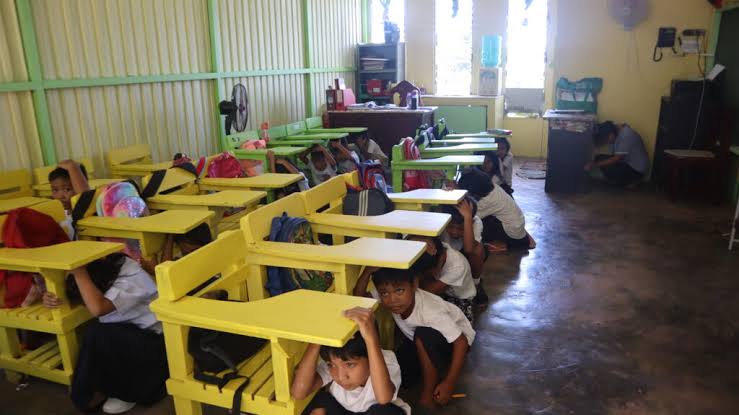
The country’s long-running National Simultaneous Earthquake Drill (NSED) program has proven its value in real-life emergencies, after students and teachers in Mindanao were seen properly responding during the magnitude 7.8 earthquake that struck Sarangani and nearby areas on June 8.
Office of Civil Defense (OCD) Administrator Undersecretary Harold Cabreros made the assessment during the observance of the second-quarter NSED on Thursday, citing viral videos showing school communities immediately executing safety protocols during the tremor.
“Nakita natin sa mga kumalat na video matapos ang lindol sa Mindanao kung paano tumugon ang mga mag-aaral at guro sa mga paaralan. Bagamat natural na magkaroon ng takot o pangamba sa ganoong sitwasyon, malinaw na nakita rin natin sa pagtugon na ’yon ang kahalagahan ng regular na earthquake drills,” Cabreros said.
He added that amid the chaos, students and teachers were able to recall and apply basic life-saving procedures taught through the drills.
“Sa gitna ng kaguluhan, naalala nila ang mga pangunahing hakbang na dapat gawin sa oras ng lindol,” he said.
The OCD chief referred to footage showing schoolchildren and educators performing the “duck, cover, and hold” technique as the strong quake shook parts of Mindanao.
Cabreros said the incident underscores the importance of continuous disaster preparedness, noting that earthquakes can strike anywhere in the country without warning.
He said the NSED, which has been conducted quarterly for the past two decades, has become a key part of the country’s disaster preparedness culture.
The OCD official also urged the public to avoid complacency and integrate preparedness into daily routines, not only during scheduled drills.
He called on local governments, schools, and private establishments to strengthen compliance with building safety standards and improve emergency contingency plans.
Cabreros likewise emphasized the importance of coordination between government agencies and communities in reducing risks during major earthquakes.
Thursday’s NSED was conducted based on a scenario involving a major earthquake generated by movement along the West Valley Fault, with simulated intensity reaching VIII under the Philippine Earthquake Intensity Scale (PEIS).
Photo courtesy of BURGOS, Ilocos Sur















Comments