
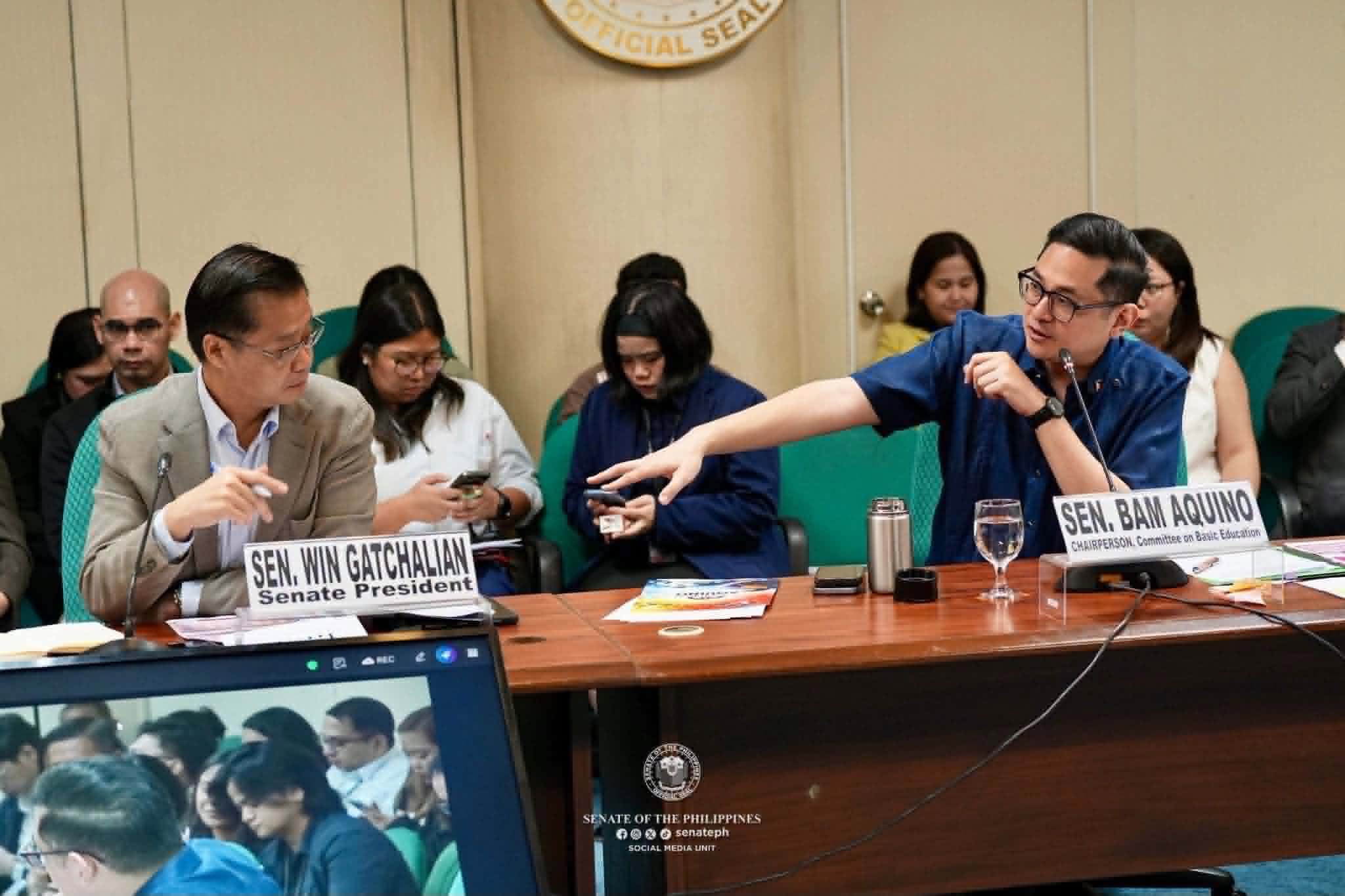
Senator Bam Aquino has urged government agencies and local government units (LGUs) to speed up the implementation of the country’s P67-billion classroom construction budget, warning that delays in using the funds could affect future education allocations.
Aquino, chairperson of the Senate Committee on Basic Education, said the success of the program should be measured not by the amount appropriated but by how quickly classrooms are built and made available to students.
“Ang tunay na sukatan ng tagumpay ay hindi kung magkano ang nailaan. Ang tunay na sukatan ay kung gaano karaming silid aralan ang naitayo at gaano kabilis ito na pakinabangan ng ating mga estudyante,” Aquino said during a Senate hearing on Thursday.
The hearing followed an EDCOM 2 site inspection at Casiglahan Village Elementary and National High School in Montalban, Rizal, where structural issues were found in some classrooms built between 2013 and 2015.
The inspection showed that 18 of the 103 classrooms constructed during the period were condemned and declared unsafe within four to five years of completion, despite the required 15-year structural warranty.
Aquino said the deficiencies worsened classroom shortages, forcing students and teachers to deal with overcrowded learning spaces and shifting schedules.
“Kada linggong naaantala ito, may guro na patuloy na nagtuturo sa dalawa o tatlo na shift. Kada buwan hindi natin naipapatayo ang mga classroom na ito, patuloy nating ipinapasa ang bigat ng problemang ito sa mga estudyante,” he said.
The national education budget for 2026 allocated about P67 billion for classroom construction, which could reach P85 billion when furniture and other facilities are included. The funding aims to support the construction of more than 20,000 classrooms.
The Department of Education (DepEd) reported that P49.8 billion has been allocated through different implementation tracks, including LGU-led procurement, Department of Public Works and Highways (DPWH) projects, and public-private partnerships.
However, local officials raised concerns over delays caused by administrative requirements, including land ownership validation and geotechnical studies.
DepEd data showed that out of more than 1,600 targeted agreements with LGUs, only 258 Memoranda of Agreement (MOAs) have been completed.
Aquino called for the release of a verified master list of beneficiary schools and LGUs to improve transparency and allow local governments to align their Special Education Fund allocations with classroom projects.
The committee also approved allowing LGUs to use tax declarations for site validation when clean land titles are unavailable to prevent delays caused by ownership issues.
Aquino also directed agencies to enforce structural warranties and hold contractors accountable for defective school buildings.
“Kung may kailangang alisin na mga problema at bottleneck, alisin po natin. At kung may kailangang pabilisin na proseso, pabilisin po natin. Dahil ang pondo ng taong bayan ay nailaan para tugunan ang pangangailangan ng taong bayan,” he said.
A Technical Working Group will meet every two weeks through online meetings to monitor MOA completion and speed up fund utilization before discussions for the 2027 national budget.
Aquino warned that failure to fully implement the classroom program could affect future funding.
“Kapag hindi ho natin naipakita na kaya nating gamitin nang maayos at mabilis ang pondong nakalaan para sa classrooms, kami po ay natatakot na posibleng mabawasan ang pondo para po sa susunod na taon,” he said.
He said the 11,000 classrooms already launched under the program remain a step toward addressing the country’s long-standing classroom shortage but stressed that faster implementation is needed to provide students with safer and more adequate learning spaces.
Photo courtesy of PH Senate

Comments