



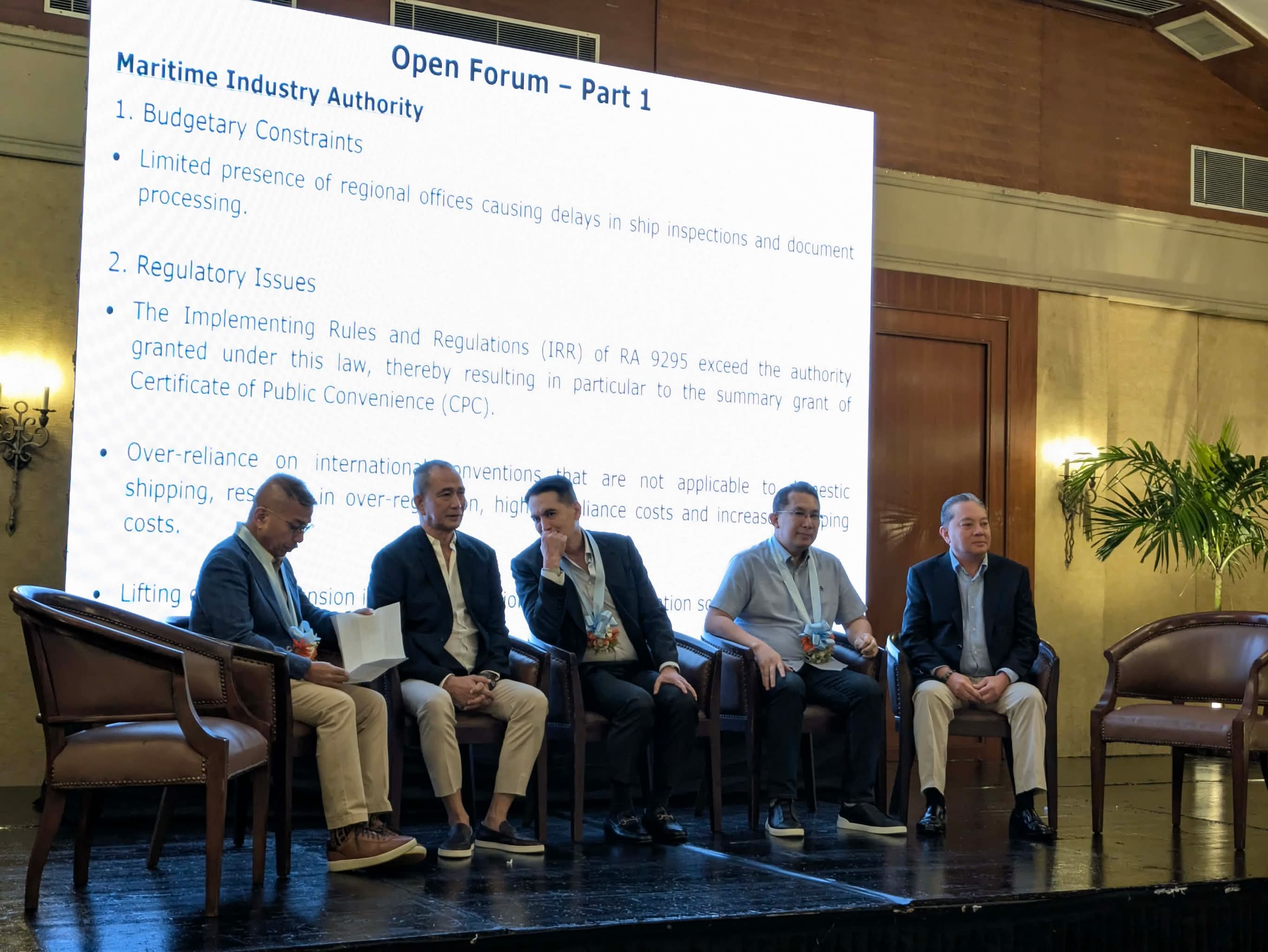
Domestic shipping stakeholders are calling for major policy reforms to improve the efficiency of the country’s maritime sector, citing outdated regulations, limited manpower, and high port costs as challenges affecting vessel operations and the movement of goods and passengers.
The concerns were raised during the Philippine Coastwise Shipping Association’s (PCSA) General Membership Meeting in Cebu on Friday, which carried the theme “One Maritime Vision: Connecting Government and Industry for a Resilient Domestic Shipping Sector.”
The event was attended by former President Gloria Macapagal-Arroyo, lawmakers, and maritime industry representatives.
PCSA Chairman Lucio Lim Jr. said the domestic shipping sector needs stronger government support to address issues that continue to affect operators and inter-island transport.
“We hope that in the presence of these three members of the House of Representatives, they will be our champions in the Congress for initiatives and to solve our concerns and the challenges that our industry is facing,” Lim said.
One of the industry’s main concerns is the lack of personnel at the Maritime Industry Authority (MARINA), which Lim said has contributed to delays in vessel inspections and document processing.
“As you all know, this has led to delays in the inspections, processing of documents, and sometimes ships are already ready to sail, but we have to be waiting for MARINA because of the severe lack of personnel,” he said.
Lim said MARINA’s workforce has seen minimal growth despite the agency’s expanding responsibilities.
He said the agency had around 1,100 personnel in 2016 and only about 1,200 in 2026, with 152 inspectors and surveyors overseeing an estimated 24,000 vessels nationwide.
He added that the agency will require additional manpower as it takes on more responsibilities, including functions related to maritime education.
Aside from staffing concerns, the PCSA urged regulators to review the application of international maritime conventions on domestic shipping, saying some requirements designed for international vessels have increased operational costs for local operators.
“And this has increased the cost of doing business for ship owners here in the Philippines,” Lim said.
The group also appealed to the Philippine Ports Authority (PPA) to consider temporary waivers for selected port fees, including passenger terminal, berthing, and roll-on/roll-off terminal charges, to provide relief to operators and reduce transportation costs.
Lim also called for simpler departure clearance procedures involving the Philippine Coast Guard, saying current requirements can contribute to delays despite existing safety measures.
The association further raised concerns over poor road access leading to ports, particularly in parts of the Visayas and Mindanao, emphasizing that efficient port connectivity is essential to improving domestic trade.
The PCSA also renewed its proposal to treat roll-on/roll-off ports as extensions of the national highway system, saying terminal fees contribute to higher costs for businesses and consumers.
House Committee on Transportation Chairman Rep. Franz Pumaren said Congress is working on measures aimed at modernizing the maritime sector and addressing industry concerns.
Among the proposed reforms are measures to strengthen the Philippine Coast Guard, establish an independent National Transportation Safety Board, amend the Domestic Shipping Development Act, reform pilotage services, and improve MARINA operations.
Pumaren acknowledged that delays in regulatory agencies directly affect shipping operations and the broader economy.
“MARINA sits at the center of vessel registration, certification, inspection, seafaring documentation, marine safety, and industry development. If MARINA systems are slow, fragmented, or outdated, the whole maritime sector feels it,” he said.
He added that reforms must balance maritime safety with the need to keep the industry competitive and avoid unnecessary burdens on operators.
“We will modernize agencies without creating unnecessary bureaucracy. We will listen to small island provinces and ordinary commuters, but also to operators who must keep the vessels running, employees paid, and routes served,” Pumaren said.
He said Congress will continue consulting maritime stakeholders to ensure future policies support safer, more efficient, and more responsive domestic shipping operations.
Photo by SBA















Comments