
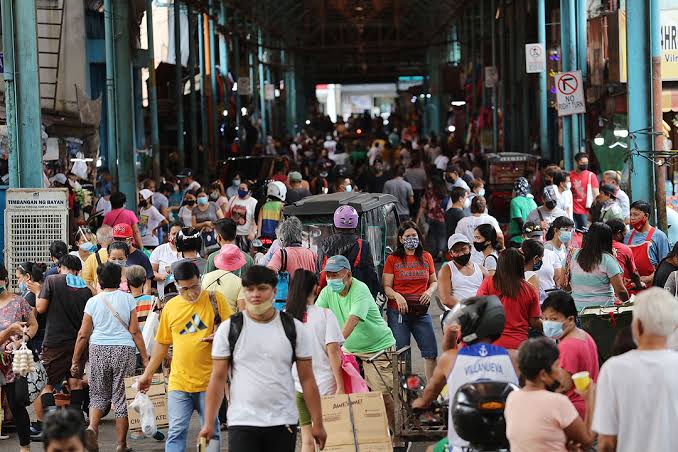
Eleven lawmakers have filed a bill seeking to provide qualified minimum-wage families with P12,000 in annual government assistance, with the subsidy designed to be spent exclusively at local micro, small, and medium enterprises (MSMEs) to support both household spending and community businesses.
House Bill 10648, or the proposed Pambansang Agapay sa Pamilya at Maliliit na Negosyo (PAMANA) Act, would grant eligible beneficiaries P1,000 per month through a digital wallet linked to the Philippine Identification System (PhilSys).
The measure was filed on Wednesday by Reps. Jude Acidre, Ziaur-Rahman Adiong, Joel Chua, Jannette Garin, Jefferson Khonghun, Gerville Luistro, Francisco Paolo Ortega, Terry Ridon, Ramon Rodrigo Gutierrez, David Suarez, and Ysabel Maria Zamora.
The lawmakers said the proposal aims to fill a gap in the country’s social protection system by extending assistance to minimum-wage earners who continue to struggle with rising living costs but are generally not covered by the Pantawid Pamilyang Pilipino Program (4Ps).
In a news release on Thursday, Acidre said many minimum-wage workers continue to face financial difficulties despite having regular employment.
“PAMANA recognizes that having a job does not always mean having economic security. It provides targeted assistance to working families who are not covered by 4Ps but continue to face serious financial pressure,” Acidre said.
Under the proposed measure, eligible beneficiaries must be headed by a minimum-wage earner, registered under PhilSys, and not be household beneficiaries of the 4Ps or any successor conditional cash transfer program.
The bill covers private-sector workers receiving the statutory minimum wage set by the Regional Tripartite Wages and Productivity Board, public-sector employees earning no more than the applicable minimum wage, and qualified self-employed and informal-sector workers earning at or below the regional minimum wage.
Unlike traditional cash assistance, the monthly subsidy may only be used at accredited local MSMEs, including sari-sari stores, public market stalls, neighborhood groceries, pharmacies, carinderias, and other community-based businesses.
Beneficiaries may spend up to P200 per day, while unused funds will remain in their digital wallets and may be used on succeeding days, subject to the same daily limit.
The subsidy cannot be withdrawn as cash, transferred to another account, or used to purchase alcohol, tobacco, online gambling services, and other prohibited goods and services.
Ortega said requiring beneficiaries to spend the subsidy at local businesses would strengthen household consumption while generating additional income for community enterprises.
“When a beneficiary buys from a sari-sari store, a market vendor, or a neighborhood food business, the assistance becomes income for a local entrepreneur and continues circulating within the community,” Ortega said.
The Department of Social Welfare and Development (DSWD) would administer the program in coordination with the Department of Trade and Industry, Bangko Sentral ng Pilipinas, Department of Information and Communications Technology, Philippine Statistics Authority, and Department of Labor and Employment.
The DSWD would verify beneficiaries by cross-checking records with the Listahanan and 4Ps databases to prevent duplicate assistance.
Qualified beneficiaries would receive PhilSys-linked digital wallets free of charge, while those without smartphones or internet access would be provided alternative payment options, including QR-enabled cash cards and offline payment systems.
Chua said the proposed digital platform would improve transparency and accountability in distributing government assistance.
“PhilSys-linked wallets, accredited merchants, spending restrictions, and public reporting are intended to reduce leakage and ensure that the subsidy reaches its intended recipients,” he said.
Based on preliminary estimates cited by the bill’s authors, the program would require about P64 billion to P68 billion annually, or less than 1 percent of the proposed national budget for Fiscal Year 2026.
To finance the program, the bill proposes the creation of the PAMANA Trust Fund, which would draw resources from identified revenue streams, including portions of incremental value-added tax collections from digital services and national government revenues under the mining fiscal regime.
“At its heart, PAMANA is a recognition that no family should be left behind simply because their income places them just beyond the reach of existing assistance,” Acidre said.
“It is a measured investment in the dignity of working families and in the small enterprises that sustain our local communities. Through this measure, we seek to ensure that government support not only eases immediate hardship, but also strengthens the foundations of shared and lasting progress.”
Photo courtesy of Business World Online

Comments