



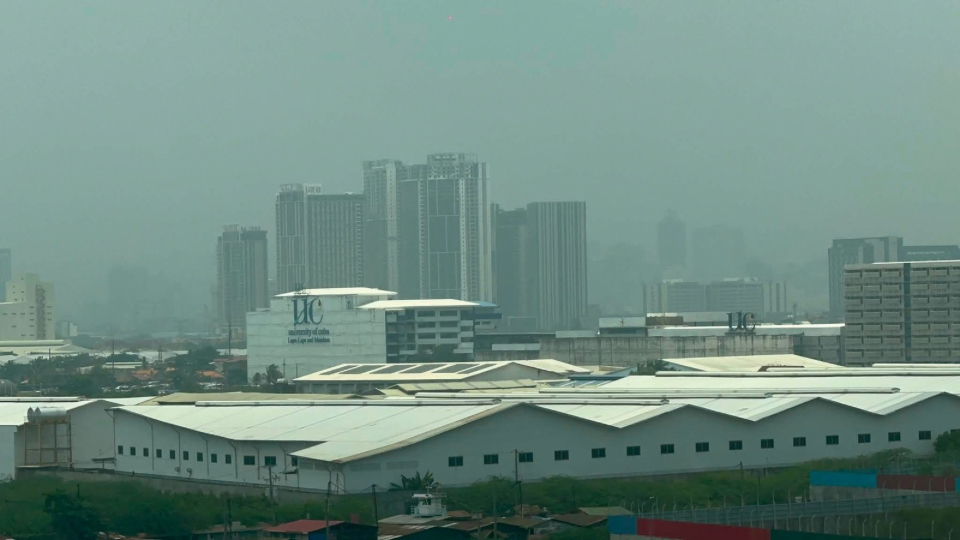
Air pollution levels in Cebu remained in the “acutely unhealthy” range as haze continued to blanket parts of the province, with environmental authorities urging residents to limit outdoor exposure and take precautions against fine particulate matter.
The Department of Environment and Natural Resources-Environmental Management Bureau Region 7 (DENR-EMB 7) recorded an Air Quality Index (AQI) of 251 at the Metro Cebu monitoring station at 4 p.m., Thursday.
The reading followed an AQI of 241 recorded at 4 a.m., showing that pollution levels remained elevated throughout the day.
DENR-EMB 7 Senior Environmental Management Specialist Arthur Niño Calupig warned residents against becoming complacent, particularly those vulnerable to respiratory problems.
“Yes, if ang atong basehan is ang concentration. Di ta angay mag kumpiyansa ani kay dako kaayo nig impact sa atong health, ilabi na sa vulnerable groups, naay mga respiratory illnesses,” Calupig said.
He said the haze has been linked to wildfire activity in Indonesia, with smoke and fine particles transported toward the Visayas and Mindanao by prevailing atmospheric conditions.
The pollution is considered a transboundary event, meaning pollutants generated in one country are carried across borders by weather and atmospheric conditions.
“Base sa atong meteorological situation, maigo jud ani ang whole Province of Cebu, even ang Bohol,” Calupig said.
The southwest monsoon, or Habagat, has contributed to the movement of smoke from the Indonesian wildfires toward the Philippines.
Calupig said, however, that local emissions also contribute to the pollution levels recorded in Cebu.
“Ang kani lang gung pollutants sa wildfire, mao lang jud ni ang naka dugang sa concentration, particularly PM 2.5.”
PM2.5 refers to fine particulate matter that can penetrate deep into the respiratory system and pose health risks when present in high concentrations.
With the air quality remaining unhealthy, Calupig advised residents to avoid unnecessary outdoor activities and stay indoors whenever possible.
“Sa mahimo mag stay lang jud indoors,” he said.
For people who need to go outside, he recommended using KN95 masks, which can provide protection against fine particulate matter.
“Ang pinaka advisable to supress fine particulate matter is KN95,” Calupig said.
The EMB also advised residents to avoid activities that could add to local pollution, including open burning.
Rain could help reduce suspended pollutants and improve air quality, Calupig said, but there is no definite timeline for the haze to clear because wildfire activity remains ongoing.
“Natural way sa makapaubos sa concentration is ang pag uwan jud,” he said.
The persistent pollution has also prompted local governments to take precautionary measures, including suspending classes in affected areas.
“Naka appreciate sad mi sa mga initiatives sa mga lakang nga gibuhat sa atong LGU nga naka suspenso jud sa klase,” Calupig said.
Calupig also clarified that even if air pollution reaches the emergency classification, it would not necessarily result in zero visibility.
“Kung anhi na sa emergency dili ingon nga maabot na dayon into zero visibility but maka apekto jud gihapon siya,” he said.
He said Cebu had previously experienced an “acutely unhealthy” air-quality episode in October 2015, but the current wildfire event is more severe based on the concentrations being recorded.
Under the EMB’s classification, an AQI above 91 falls under the emergency category, when everyone is advised to remain indoors and minimize exposure to polluted air.
With current readings already at an acutely unhealthy level, Calupig said residents should continue taking precautions and following official advisories while monitoring of air quality continues.
Photo by Kaiser Jan Fuentes















Comments