



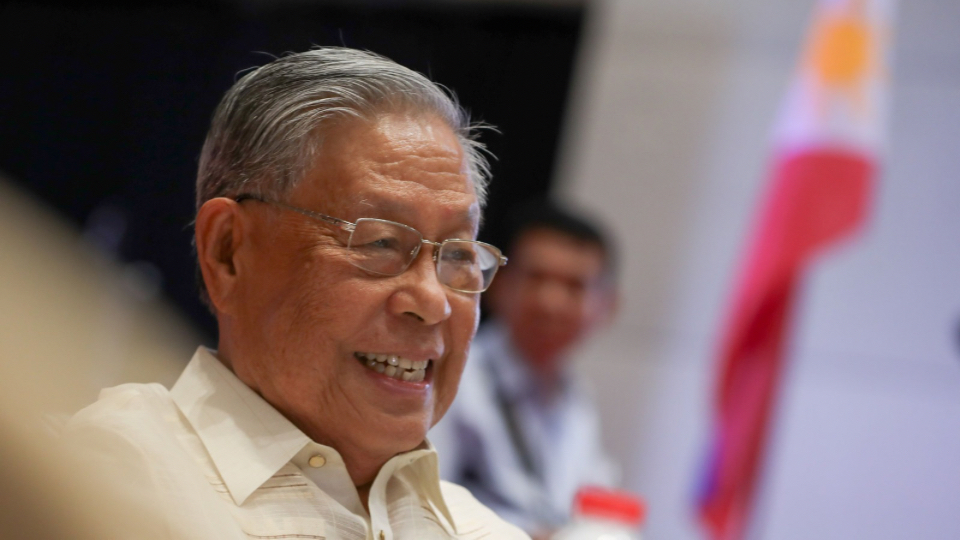
Retired Chief Justice Hilario Davide Jr. said Wednesday that the two-thirds threshold for convicting Vice President Sara Duterte in her impeachment trial should be based on senators who are legally and physically qualified to vote, rather than automatically on the Senate’s full 24-member roster.
Davide presented the position in a memorandum entered into the Senate impeachment court record as senator-judges heard amici curiae on the constitutional meaning of “all the Members of the Senate” under Article XI, Section 3(6).
The Constitution states that an impeached official cannot be convicted without the concurrence of two-thirds of all the Members of the Senate.
Davide, who was among the delegates of the 1971 Constitutional Convention that drafted the 1973 Constitution and a member of the 1986 Constitutional Commission that drafted the 1987 Constitution, said there had been no debate among the framers on the issue.
He said the reference to “Members” in the constitutional provisions should be understood to cover living senators who are capable of exercising their powers and performing their duties and are not barred by legal restraints or impediments.
“It was presumed and assumed that when the Constitution mentioned ‘two-thirds’ of all the Members of the Batasang Pambansa in the 1973 Constitution and of the Senate in the 1987 Constitution, or three-fourths of all the Members of the Senate in the 1935 Constitution, the word MEMBERS refers to living persons who are not suffering from any mental, physical or health conditions, which render them incapable of exercising their powers or performing their duties as senators, or who are prohibited to do so by reason of some legal restraints or impediments,” he said.
“This is the spirit of the provision. It could not be otherwise. Any interpretation to the contrary would defy reason, logic and common sense; tolerate an absurdity; and perpetuate an injustice,” he stressed.
Davide said the framers could not have intended “All Members” to include senators who had resigned or been expelled, those suffering from mental or physical incapacity, or those unable to participate because they were outside the Philippines, missing or in hiding to avoid arrest.
He also included senators who cannot exercise their rights and privileges because of legal restraints, including those facing plunder or other criminal charges in court and those who have been convicted and are serving their sentences.
“Clearly then, the basis of computing the two-thirds must be the number of senators who are qualified to vote, not the 24 in the present Senate,” Davide said.
The issue arose from a challenge by Senator-judge Erwin Tulfo over whether senators unable to participate in the final vote should remain part of the base used to calculate the required votes. The impeachment court had previously adopted a “hard 16” position based on two-thirds of the full 24-member Senate.
Davide’s memorandum also cited Supreme Court jurisprudence recognizing that election to the Senate does not by itself remove restrictions imposed by detention.
In Trillanes IV v. Pimentel, the Supreme Court considered then-Senator Antonio Trillanes IV’s request to leave detention to attend Senate sessions and perform legislative functions. The case, however, did not involve an impeachment proceeding or determine how a detained senator should be counted in an impeachment voting threshold.
Davide also addressed whether a senator-judge who did not attend or substantially participate in the impeachment proceedings may vote on the final question.
He said each senator-judge should be guided by the oath taken upon assuming the role and must perform the duties required of a senator-judge.
“Accordingly, a Senator-Judge who did not attend any session of the Court for any reason whatsoever or who never acted or performed the duties as a Senator-Judge must be deemed to have never participated in the performance of the duties as such,” he said.
Davide said such a senator-judge should fall under the category of a person outside the Philippines or whose whereabouts are unknown.
For senator-judges who attended but did not substantially participate, Davide left the matter to their conscience and sense of duty.
“As to those who did not substantially participate in the impeachment proceedings, the undersigned leaves this matter to the conscience and sense of duty to those involved,” he said, stressing that judges are expected to be present, listen to witness testimony and reflect on the proceedings.
The Senate impeachment court is considering the legal views of retired Supreme Court justices and other experts before resolving the disputed voting threshold. Oral arguments by the prosecution and defense are scheduled for Sept. 23.
Photo courtesy of ABS-CBN News















Comments