



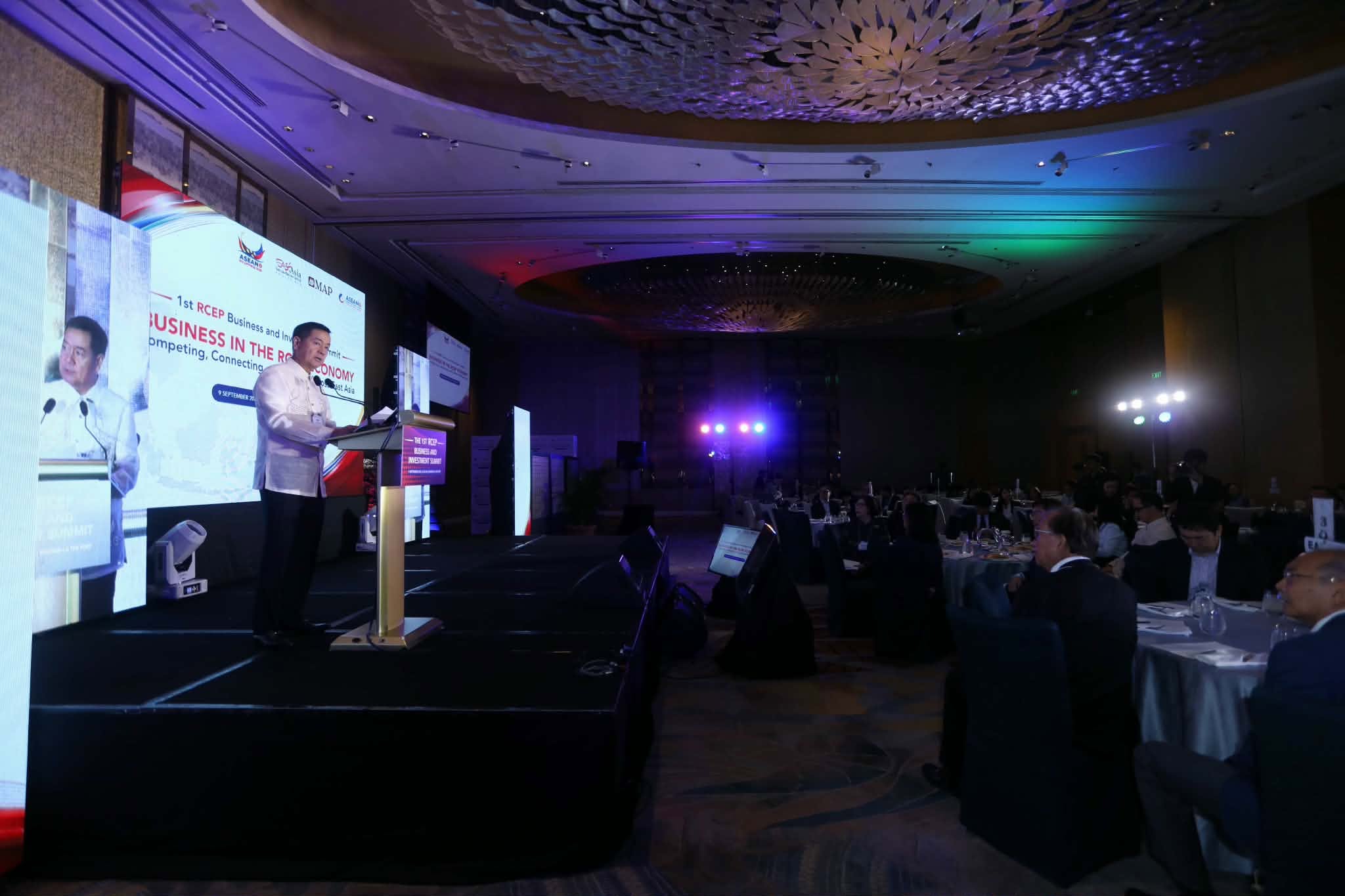
The East Asia Business Council (EABC) called for stronger business participation in regional trade as the Regional Comprehensive Economic Partnership (RCEP) prepares for its first General Review.
The EABC held its first RCEP Business and Investment Summit in Manila, bringing together business leaders, policymakers, economists and regional stakeholders to discuss how to strengthen economic integration amid an uncertain global trading environment.
Trade and Industry Secretary Ma. Cristina A. Roque urged businesses to provide specific feedback on trade barriers that affect their operations, including customs procedures and sourcing requirements.
The Philippines recorded a 15.4% increase in exports in 2025, reaching an all-time high, but Roque said businesses must make fuller use of free trade agreements.
The RCEP market covers more than 2.3 billion people and offers opportunities for supplier diversification, wider production networks and access to customers across the region.
EABC Chairperson Jay Yuvallos said businesses now need to balance efficiency with resilience as supply chains face disruptions and uncertainty.
Yuvallos said regional integration can give businesses a strategic advantage by helping them build stronger connections across markets.
The Philippines is part of the ASEAN+3 framework covering China, Japan and South Korea and has 23 free trade agreements. Its export strengths include semiconductors and agricultural products, while policymakers are seeking greater participation in higher-value regional production.
The summit also highlighted the need to help micro, small and medium enterprises (MSMEs) take part in regional value chains. Businesses that cannot immediately become direct exporters can participate as suppliers, distributors, service providers or other business partners.
The EABC identified digitalization, sustainability and the circular economy, supply chain resilience and MSME participation among its priorities under the Philippines’ 2026 chairmanship.
The council said the first RCEP General Review provides an opportunity for businesses to identify practical problems and recommend improvements in how the trade agreement works.
The EABC was established in 2003 and brings together business representatives from the 13 economies covered by ASEAN+3, with representation from large companies and small and medium enterprises.The East Asia Business Council (EABC) called for stronger business participation in regional trade as the Regional Comprehensive Economic Partnership (RCEP) prepares for its first General Review.
The EABC held its first RCEP Business and Investment Summit in Manila, bringing together business leaders, policymakers, economists and regional stakeholders to discuss how to strengthen economic integration amid an uncertain global trading environment.
Trade and Industry Secretary Ma. Cristina A. Roque urged businesses to provide specific feedback on trade barriers that affect their operations, including customs procedures and sourcing requirements.
“We need your feedback. Tell us what needs to work better—customs procedures, sourcing requirements, and other barriers that affect your operations,” Roque said.
The Philippines recorded a 15.4% increase in exports in 2025, reaching an all-time high, but Roque said businesses must make fuller use of free trade agreements.
“These FTAs remain as agreements unless we maximize or use their full potential,” she said.
The RCEP market covers more than 2.3 billion people and offers opportunities for supplier diversification, wider production networks and access to customers across the region.
EABC Chairperson Jay Yuvallos said businesses now need to balance efficiency with resilience as supply chains face disruptions and uncertainty.
“The business model that served us for decades was built around ‘Just-in-time.’ Now, ‘Just-in-time’ must increasingly be matched with ‘Just-in-case,’” Yuvallos said. “In other words, resilience has to become part of how we design our value chains.”
Yuvallos said regional integration can give businesses a strategic advantage by helping them build stronger connections across markets.
The Philippines is part of the ASEAN+3 framework covering China, Japan and South Korea and has 23 free trade agreements. Its export strengths include semiconductors and agricultural products, while policymakers are seeking greater participation in higher-value regional production.
The summit also highlighted the need to help micro, small and medium enterprises (MSMEs) take part in regional value chains. Businesses that cannot immediately become direct exporters can participate as suppliers, distributors, service providers or other business partners.
“We need businesses—especially our MSMEs—to participate in regional value chains, and we need to make it easier for companies to understand and actually use the opportunities that RCEP provides,” Yuvallos said.
The EABC identified digitalization, sustainability and the circular economy, supply chain resilience and MSME participation among its priorities under the Philippines’ 2026 chairmanship.
The council said the first RCEP General Review provides an opportunity for businesses to identify practical problems and recommend improvements in how the trade agreement works.
“The future of regional integration will not be written by agreements alone. It will be built by the businesses, institutions, and people who choose to connect,” Yuvallos said.
The EABC was established in 2003 and brings together business representatives from the 13 economies covered by ASEAN+3, with representation from large companies and small and medium enterprises.















Comments