



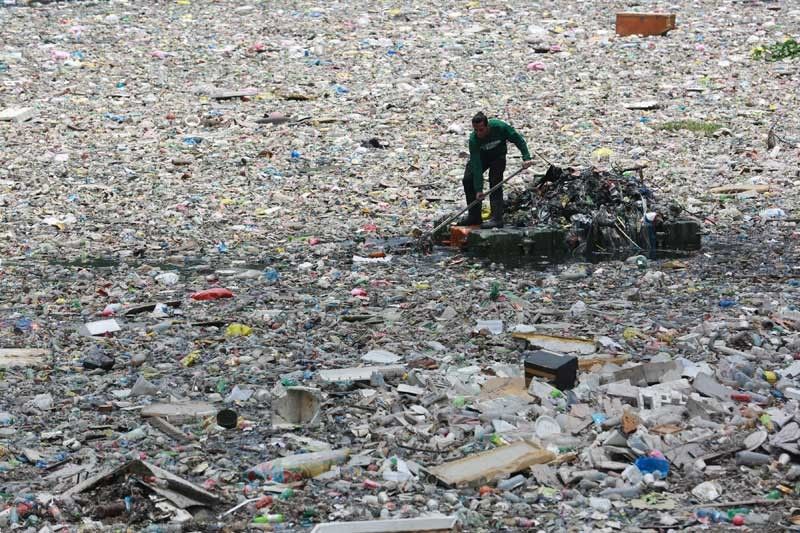
The Philippines is aiming to cut plastic pollution by 85% by 2040 under a new national roadmap that calls for changes across the plastics value chain, from product design and consumption to waste collection, recovery and recycling.
The Philippine National Plastic Action Roadmap 2026–2040 was launched in Makati City on Sept. 25, bringing government agencies, businesses, local governments, communities and other stakeholders under a common framework for addressing plastic pollution.
The Department of Environment and Natural Resources (DENR) said the roadmap seeks to connect existing laws, programs and initiatives while establishing a long-term direction for reducing plastic pollution.
DENR Secretary Juan Miguel “Mitch” Cuna said the roadmap will provide a common framework for existing targets and initiatives and help direct investments toward areas that need them most.
“Through this Roadmap, the Philippines aims to reduce plastic pollution by 85 percent by 2040. Achieving this requires sustained action across planning cycles and administrations with clear milestones, measurable progress, and accountability,” Cuna said.
The roadmap was developed through the National Plastic Action Partnership Philippines in partnership with the World Economic Forum and its global action partnerships.
At a press briefing, Al Orolfo, DENR director for Foreign Assisted and Special Projects Services, said the plan addresses both the upstream and downstream aspects of plastic management.
These include product design, production and consumption, as well as the collection, recovery and recycling of plastic waste and the management of residual waste.
Orolfo said meeting the 2040 target would require changes throughout the plastics value chain and corresponding changes in public behavior.
He also pointed to single-use sachets as an area where producers could consider redesigning products or developing alternatives that remain affordable to Filipino consumers.
The roadmap identifies 10 mutually reinforcing outcomes, with six focused on core system changes and four covering enabling conditions such as governance, financing, data, technology and behavior change.
The DENR said the plan envisions a plastics system that is circular, inclusive, resilient and accountable by 2040, combining measures to prevent plastic waste with better management of waste that remains.
The launch establishes the strategic direction through 2040, but detailed implementation work will continue, Orolfo said.
The next phase will identify the resources required, agencies and organizations responsible for specific outcomes, and the groups that will carry out the measures.
Financing is expected to come from several sources, including the private sector, local governments and the national government, along with innovative financing mechanisms.
Roisin Greene of the Global Plastic Action Partnership said the Philippines is among 25 countries with national partnerships focused on addressing plastic pollution.
She cited progress in implementing the Extended Producer Responsibility law and private sector initiatives, including a task force focused on single-use sachets.
Greene also said the roadmap includes safeguards for informal waste workers, who currently collect three-quarters of materials reaching domestic recyclers, as well as micro, small and medium-sized enterprises.
She also noted the increasing number of local government units adopting circular economy initiatives.
“What we need to do now is to capitalize on this, to make sure they don’t stay just champions, but they also inspire others and bring them along, and that’s probably one of the next phases, and possibly the roadmap will help us in this direction,” Greene said.
Christophe Bahuet, United Nations Development Programme Resident Representative in the Philippines, said plastic pollution also has implications for public health and requires participation beyond government and businesses.
“But let’s be honest, it’s also individual behavior. It is an awareness that we all need to have that plastic pollution is bad and we can all do something against it. So it’s not only a whole of government or whole private sector, it’s actually a whole of a society engagement,” he said.
Following the launch of the abridged framework, the DENR said it will work on detailed resource requirements, agency lead assignments and sectoral benchmarks needed to implement the 2040 targets.
Cuna, who was in New York attending the United Nations General Assembly, said he hopes the effects of the roadmap will be evident by 2040 through improvements in the country’s environment and communities.
“By 2040, our progress should be evident in healthier rivers and seas, cleaner and more resilient communities, efficient and productive resource use, and the Filipino people equitably sharing the benefits of a truly circular economy through better social services and secure livelihoods,” Cuna said.
Photo courtesy of PhilStar















Comments