



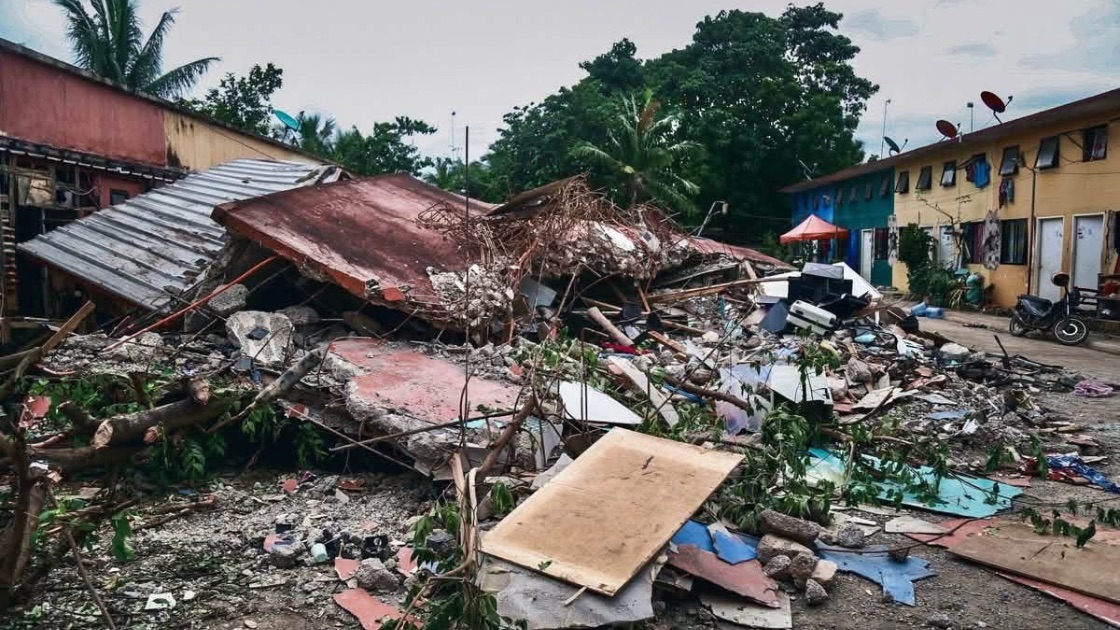
A year after a magnitude 6.9 earthquake struck northern Cebu, the province is moving from emergency response to a longer recovery effort that goes beyond rebuilding damaged structures.
The Sept. 30, 2025 earthquake disrupted classrooms, livelihoods and businesses, damaged critical infrastructure and exposed communities to geological hazards that could influence where people can safely live and build.
As Cebu marked the first anniversary of the disaster on Wednesday, the provincial government said it is implementing a three-year rehabilitation program requiring an estimated P19.28 billion.
Provincial Disaster Risk Reduction and Management Office (PDRRMO) head Dennis Pastor said the province has committed about P750 million in its own resources for recovery measures, including temporary learning spaces, bridge rehabilitation and agricultural assistance.
“Layo-layo pa jud ta in terms of recovery but we are doing our best,” Pastor said.
The Post-Disaster Needs Assessment presented to the Provincial Disaster Risk Reduction and Management Council earlier this year estimated that the earthquake caused P9.24 billion in damages and P47.74 billion in losses across various sectors.
The social sector accounted for P4.05 billion in physical damage and P2.19 billion in losses, while agriculture, fisheries, tourism and trade recorded P718 million in damage but P9.52 billion in losses as economic activities were disrupted.
The productive sector’s recovery requirement was estimated at P1.98 billion.
Education remains among the most visible areas of continuing recovery, with around 3,000 classrooms sustaining major or minor damage.
Pastor said the provincial government allocated P269 million for temporary learning spaces, but the province has so far reached about 40% of its target.
Infrastructure repairs are also ongoing.
Gov. Pamela Baricuatro said P238 million has been allocated for damaged bridges, including a bridge in Borbon connecting the municipality to Tabogon.
She said the province decided to undertake the Borbon bridge repair after national funding had not yet been made available, leaving residents to take a longer route.
“It was supposed to be handled by DPWH, but since wala pa man oy funding, and then we need to fix that kay layo kaayo tuyokan ang mga tao… the province took it to repair the bridge na lang,” Baricuatro said.
The Provincial Agriculture Office has also received P30 million for earthquake recovery interventions.
Beyond rebuilding damaged facilities, the provincial government is replenishing food and non-food supplies in northern and southern Cebu as part of efforts to strengthen preparedness for future emergencies.
Tourism, meanwhile, remains another sector recovering from the disruption caused by the earthquake.
“It’s a work in progress. We’re really doing our part,” Baricuatro said.
The recovery also involves addressing geological risks and determining where communities can safely rebuild, adding another layer to the province’s rehabilitation work.
For Baricuatro, the earthquake also underscored the need to strengthen Cebu’s disaster response capacity.
The provincial government has since added personnel to the PDRRMO, established a command center in Barangay Busay and acquired additional rescue equipment.
“Now is an opportunity to strengthen our PDRRMO,” she said.
PDRRMO data showed that 81 people died in the earthquake.
Baricuatro said financial assistance for earthquake victims has already been completed, but the broader recovery remains unfinished.
“Daghan natag na-achieve. Naka-payout na ta, naay financial assistance, human na nato nahatag na tanan katong nabiktima sa earthquake,” she said.
A year after the disaster, Cebu’s recovery has therefore shifted from clearing rubble and providing immediate assistance to restoring essential services, repairing infrastructure, supporting livelihoods and tourism, addressing geological risks and preparing communities for future emergencies.
The provincial government has acknowledged that the work will take time, with the rehabilitation program extending over several years.
Photo by Jacq Hernandez















Comments