



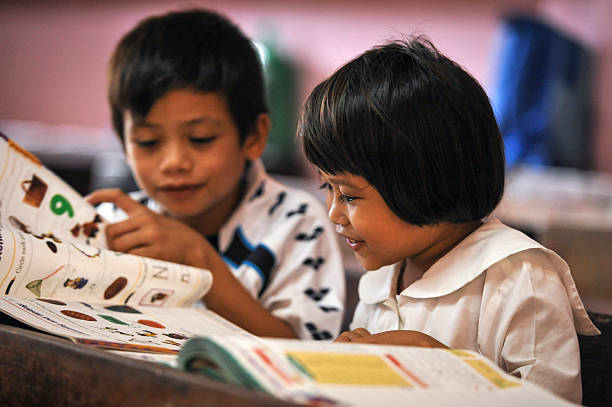
Nearly half of learners assessed in Davao Region and Davao City struggled with reading at the start of School Year 2026-2027, while gaps persisted into senior high school, according to the Second Congressional Commission on Education (EDCOM 2).
The Department of Education’s (DepEd) Comprehensive Rapid Literacy Assessment (CRLA) conducted in June found that 48% of assessed learners across Region XI and 45% in Davao City fell under the Low-Emerging and High-Emerging reading levels.
Under DepEd guidelines, Low-Emerging learners have limited mastery of letters and their sounds and struggle to blend sounds into simple words. High-Emerging learners can recognize most letters but continue to have difficulty decoding words appropriate for their grade level.
The findings mirror the national picture, where 45% of assessed learners were also classified as struggling readers, EDCOM 2 said.
Its data further showed that reading proficiency declined as learners advanced through school, from 30.52% in Grade 3 to 19.56% in Grade 6, 0.74% in Grade 10 and 0.40% in Grade 12.
However, literacy gaps varied across Davao Region’s provinces, based on DepEd’s end-of-school-year CRLA results for Grades 1 to 3 in March 2026.
Davao Occidental recorded the highest proportion of struggling readers among the region’s five provinces at 18.5%, or 3,471 learners. Davao del Norte followed with 14.8%, or 8,502 learners, while Davao Oriental recorded 13.4%, or 4,522 learners.
Davao de Oro posted 10.1%, equivalent to 4,047 learners, while Davao del Sur had 9.5%, or 3,346 learners.
At the municipal level, Talaingod in Davao del Norte recorded the highest proportion of struggling readers at 49.6%, or 1,184 learners.
San Isidro and Kapalong, also in Davao del Norte, followed with 24.6% and 23%, respectively, although their reported counts were 32 and 37 learners.
Don Marcelino in Davao Occidental recorded 22.3%, or 600 learners, while Malita had 21.6%, or 1,507 learners.
Among municipalities with lower proportions, Mawab in Davao de Oro recorded 3.6%, or 80 learners, followed by Compostela at 3.8%, or 155 learners, and Nabunturan at 5.9%, or 247 learners.
“The learning crisis did not happen overnight, it has compounded over the years. We must act now to address illiteracy, especially among children in Grades 1 to 3. Every child who continues to struggle with reading needs timely support. Otherwise, they risk moving up to the next grade without fully understanding their lessons. We must work together to ensure that no child is left behind in learning,” EDCOM 2 Executive Director Karol Mark Yee said.
The literacy gap remains evident among older learners, according to results from the pilot Senior High School Literacy and Numeracy Assessment administered to Grade 11 students in public and private schools at the end of School Year 2025-2026.
In Davao City, 25% of assessed learners, or 8,453 students, were classified as Independent Readers. Another 29%, or 10,097 learners, were at the Instructional level, while 46%, or 15,914 students, were at the Frustration level.
Across Region XI, 21% of assessed senior high school learners were Independent Readers, higher than the national figure of 13%. However, 34% remained at the Instructional level and 45% at the Frustration level.
Provincial results showed further disparities. Davao Oriental had the highest proportion of learners at the Frustration level at 63%, or 4,200 students, followed by Davao del Norte and Davao Occidental at 56% each, representing 4,050 and 1,827 learners, respectively.
Yee said weak reading skills could prevent students from understanding lessons across subjects, including science and mathematics.
“We are seeing Grade 8 students who struggle to read a sentence, and Grade 9 students who should be studying Shakespeare but still struggle to read a paragraph. At their grade-level, they are also expected to learn physics and geometry. But how can they absorb these lessons when they are still struggling with reading comprehension?” he said.
He said interventions should begin in the early grades rather than wait until learners reach senior high school, when accumulated learning gaps may be more difficult to address.
“We cannot wait until learners reach senior high school before addressing the gaps. The data shows us that when these difficulties are not addressed early, they can compound and become harder to overcome,” Yee said.
EDCOM 2 called on local government units, universities, parents and communities to work with DepEd to improve literacy outcomes.
Yee said municipalities where mayors actively monitor reading progress and school performance tend to make greater gains, underscoring the importance of local leadership and sustained community involvement in helping struggling readers.
📷 Getty Images















Comments