



The Philippines is preparing to expand its artificial intelligence infrastructure and workforce, with Cebu identified as one of four future regional hubs under a P1.9-trillion government roadmap.
The Philippines AI+ Infrastructure Masterplan 2026–2033 identifies Cebu, Iloilo, Davao and Cagayan de Oro as regional nodes that could support the country’s planned expansion of data centers and other AI-related facilities.
Ambassador-at-Large and Special Envoy for Trade Relations Jose E.B. Antonio said the infrastructure program should also create opportunities for Filipino workers and businesses to move into more specialized, higher-value services.
The government launched the final version of the masterplan on Sept. 8, outlining US$34.4 billion in investments to position the Philippines as a regional AI infrastructure hub.
The roadmap targets a 30-fold increase in AI-oriented data-center capacity, from about 50 megawatts to 1.5 gigawatts by 2033. It sets an initial deployment target of approximately 400 MW by 2030.
Antonio said the initiative should not focus solely on building data centers and expanding computing capacity.
Its success would also depend on whether Filipinos gain the skills and opportunities to perform more complex, creative and technical work.
“AI should be treated as a partner to Filipino talent, not as a substitute for Filipino ambition. Our opportunity is to equip people with the skills, tools, and confidence to build with AI—to solve problems, create new services, and move higher up the value chain. Infrastructure matters, but inclusive growth is the outcome we must deliver,” Antonio said.
The masterplan includes a reskilling program for 1.3 million information technology and business process management (IT-BPM) workers.
It also projects more than 500,000 AI-related jobs and another 175,000 jobs linked to AI infrastructure projects by 2033.
The program builds on the IT-BPM sector’s expansion beyond traditional call-center and outsourcing operations. Philippine companies have developed specialized services in engineering, illustration, animation, game development, financial analysis and healthcare information.
Antonio said the sector’s growing range of services demonstrates the capacity of Filipino professionals to take on higher-value work.
The AI roadmap could accelerate this shift and allow more local businesses to participate in the global AI economy.
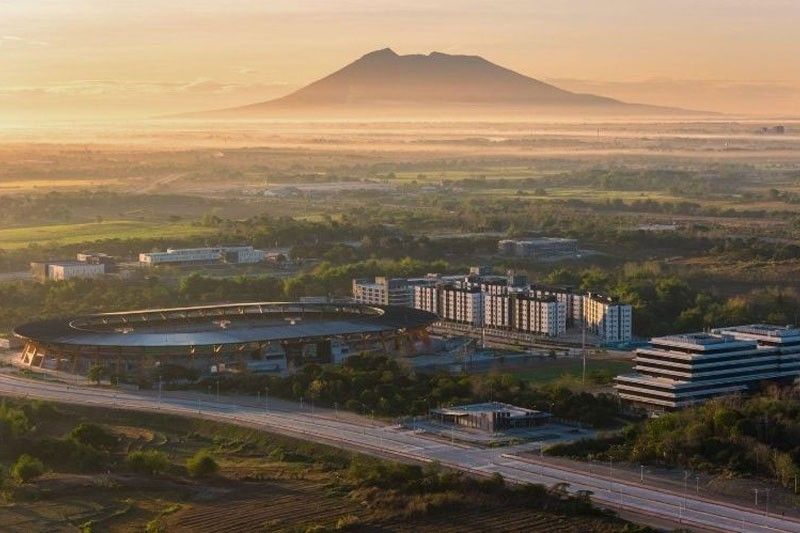
Under the infrastructure plan, the Clark-Bataan corridor will serve as the primary anchor, while Batangas-Aurora will function as a strategic gateway.
Subic and Calabarzon will provide additional support hubs, with Cebu and the three other cities serving as future regional nodes.
The initiative also complements efforts to attract foreign investments and strengthen the Philippines’ position in global technology supply chains.
These include the Luzon Economic Corridor, a trilateral initiative involving the Philippines, United States and Japan to encourage infrastructure investment and economic activity along the Subic-Clark-Manila-Batangas route.
The government is also pursuing a proposed Pax Silica Industrial Hub in New Clark City, Tarlac, envisioned as a center for advanced manufacturing, technology and logistics.
Antonio said developing a competitive AI economy would require more than computing capacity.
Reliable energy, trusted data, strong connectivity and workers who can adapt to technological changes would also be essential.
The masterplan identifies natural gas as a source of immediate power supply for AI infrastructure.
It also sets a target of sourcing 40% of the electricity used by these facilities from renewable energy, including solar and geothermal, by 2033.
The Department of Energy is also exploring nuclear power as a longer-term energy option.
Private investors are expected to provide US$21 billion, or about 61% of the total investment requirement, while public sources will cover the remaining amount.
The roadmap projects that gains in productivity and the development of new digital services could increase the country’s gross domestic product by 10% to 12% by 2033.
Antonio said the Philippines could attract investors by highlighting its skilled and adaptable workforce, cost competitiveness and large talent pool.
“The next chapter of Philippine competitiveness will be defined by what our people can create with technology,” he said.















Comments