



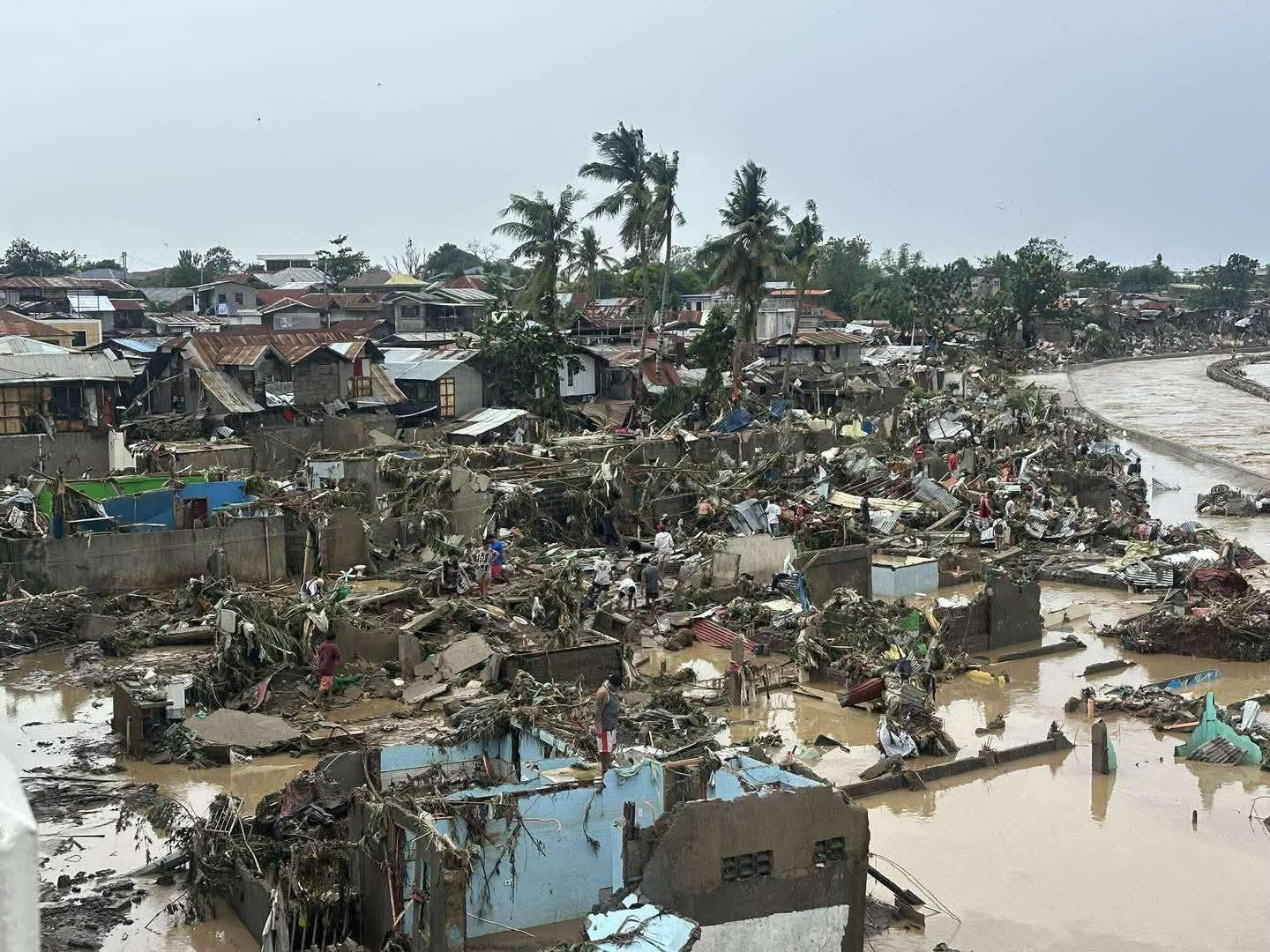
More than P11 billion is still needed to rehabilitate damaged infrastructure and public facilities in Cebu, underscoring the scale of recovery work a year after Typhoon Tino unleashed deadly floods across the province.
Despite emergency assistance and ongoing infrastructure interventions, the amount required to restore damaged roads, bridges, schools, health centers and other facilities shows that communities continue to face a long road to recovery.
Tino, internationally known as Kalmaegi, struck Cebu from Nov. 3 to 4, 2025, bringing torrential rains that caused widespread flooding, particularly in communities near rivers and other waterways.
The Provincial Disaster Risk Reduction and Management Office (PDRRMO) recorded 143 fatalities, 5,079 injured individuals and 45 missing persons. At least 28 local government units were affected.
The disaster also damaged public infrastructure, leaving 22 bridges and 28 roads in need of repairs.
Thousands of houses were damaged or destroyed.
According to Aldwin Empaces during a press briefing, the provincial government under Gov. Pamela Baricuatro has pursued emergency assistance and longer-term rehabilitation measures to help affected communities.
In the immediate aftermath, the Capitol mobilized provincial resources and coordinated with private organizations, volunteers and donors to provide relief to displaced families.
The PDRRMO reported that food and non-food assistance worth P21.98 million had been distributed. These included family food packs, rice, drinking water, clothing, sleeping kits, hygiene supplies and solar lamps, as well as prepared meals for evacuees.
Health interventions were also provided in evacuation centers, including medicines, water and sanitation supplies, nutrition commodities, tetanus toxoid vaccines and doxycycline. Mental health and psychosocial support services were extended to affected communities.
For households whose homes were damaged, the provincial government allocated P142.25 million in financial assistance covering 14,238 families across 28 local government units.
Qualified beneficiaries received P10,000 each through the Provincial Social Welfare and Development Office. Balamban had the largest number of listed recipients at 4,363, followed by Talisay City with 4,207 and Mandaue City with 1,133.
The PDRRMO also reported an additional P27 million in financial assistance for affected families.
Infrastructure rehabilitation has included funding for damaged roads and bridges. The Capitol earmarked P100 million for the repair and rehabilitation of a road in Tabogon and another P206.6 million for infrastructure projects in Compostela and Balamban.
The Compostela allocation covers five bridges worth a combined P104.6 million and a road project costing P59.9 million.
In Balamban, two bridges with a combined project cost of P42.1 million are also included in the provincial government’s interventions.
The recovery program also covers farmers and fisherfolk whose livelihoods were affected by the typhoon.
The provincial government spent P10.6 million on insurance premiums. As of Sept. 30, 2026, insurance coverage had been secured for 32,831 farmers and 8,000 fishing bancas to help protect them against disaster-related losses.
Still, the assistance and projects rolled out since the disaster have not completed the province’s recovery.
With more than P11 billion in rehabilitation requirements, Cebu faces the continuing task of restoring damaged public facilities and essential infrastructure while strengthening communities against future disasters.
📷 Capitol PIO















Comments