



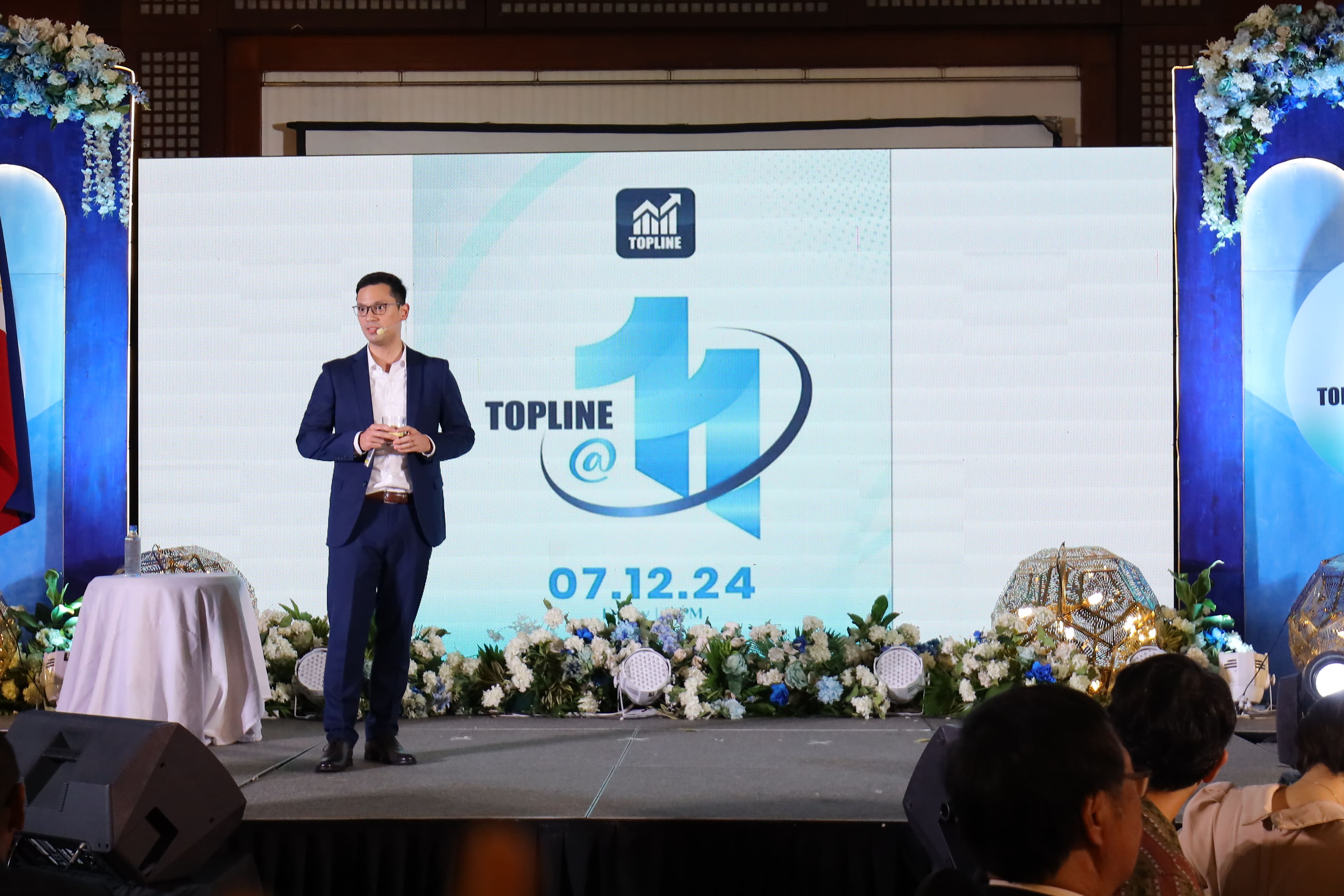
Cebu-based Top Line Business Development Corp. is evaluating investments in additional petroleum storage facilities across the Visayas to strengthen regional fuel supply and support its expanding trading and retail operations.
Eugene Erik Lim, the company’s chairman, president and chief executive officer, said the proposed investments are intended not only to increase the company’s capacity but also to help address the region’s long-term energy security needs.
“Not only just for the company, but for energy security, hopefully for the Visayas. So that’s what we’re looking at,” Lim said in an interview.
The Visayas consumes an estimated 1.1 billion liters of fuel annually, making storage facilities closer to major consumption centers important to regional supply.
Lim noted that the Philippines imports about 98 percent of its petroleum requirements, leaving the country exposed to geopolitical tensions, shipping disruptions and fluctuations in international oil prices.
Citing Department of Energy data, he said the country’s petroleum inventory covers about 53 days of consumption, compared with Japan’s nearly yearlong supply buffer.
Lim welcomed government plans to establish additional petroleum stockpiling facilities in Bataan but questioned the timeline and whether the proposed infrastructure would adequately serve other islands.
“The only question is, what’s the timeline for those stockpiling activities? And then if it’s going to be Bataan, what will happen to the other islands?” he said.
Top Line currently operates depots in Mandaue City and Negros Oriental. The company is also refurbishing its Ludo facility, which has an estimated storage capacity of 30 million liters, to accommodate larger fuel shipments.
Lim said the improvements would allow the facility to receive bigger cargoes, although its actual utilization would depend on supply availability, customer requirements and delivery schedules.
The company is also assessing other potential storage sites, considering investment costs, proximity to coastal areas and the time needed to secure environmental clearances and regulatory permits.
To diversify its supply sources, Top Line uses its Singapore-based trading operations to explore petroleum purchases from Singapore, South Korea and other Southeast Asian markets. It also sources products domestically.
Lim said the company was developing an interconnected energy platform spanning imports, storage, distribution and retail.
The expansion comes as Top Line reported a 77.2 percent increase in net income to P194.22 million in the first nine months of 2026, from P109.57 million in the same period last year.
Consolidated revenue more than doubled to P6.42 billion from P3.09 billion, representing a 107.4 percent increase.
Commercial fuel trading accounted for P5.81 billion, or 90.5 percent of total revenue, compared with P2.96 billion a year earlier. Sales volume in the segment rose 38.8 percent to 92.11 million liters from 66.34 million liters.
Its retail subsidiary, Light Fuels Corp., also recorded significant growth as it expanded its service station network across the Visayas. Retail revenue surged 357.8 percent to P607.54 million from P132.72 million, while retail fuel volume climbed 255.5 percent to 8.53 million liters from 2.4 million liters.
Combined commercial and retail fuel sales reached 100.64 million liters, up 46.4 percent from 68.74 million liters in the first nine months of 2025.
Gross profit increased 96.1 percent to P563.93 million, while earnings before interest, taxes, depreciation and amortization rose 65.5 percent to P498.17 million.
Third-quarter revenue reached P2.58 billion, up 130.7 percent from P1.12 billion a year earlier. Net income more than doubled to P71.06 million from P33.32 million, while fuel sales volume grew 58.9 percent to 38.63 million liters.
On the outlook for petroleum prices, Lim expects relatively softer prices in the near term but warned that geopolitical developments and global energy market movements could trigger renewed volatility.
He said local fuel prices are influenced by international crude and refined petroleum benchmarks, foreign exchange movements, shipping expenses and insurance premiums.
Tensions along major maritime routes, particularly the Strait of Hormuz, could increase freight and insurance costs, adding to the price of imported petroleum. Philippine fuel prices are also closely linked to international benchmarks, including petroleum trading prices in Singapore.
Despite these uncertainties, Top Line expects fuel volumes to continue growing, supported by competitive pricing and its established customer base.
Light Fuels plans to open more service stations before the end of the year. The company is also exploring other revenue streams, including automated car washes, convenience store partnerships, electric vehicle charging facilities and solar installations on service station canopies.
Since its listing in 2025, Top Line has distributed approximately P128.42 million in cumulative dividends to common and preferred shareholders.
📷 Media courtesy of Topline PH















Comments