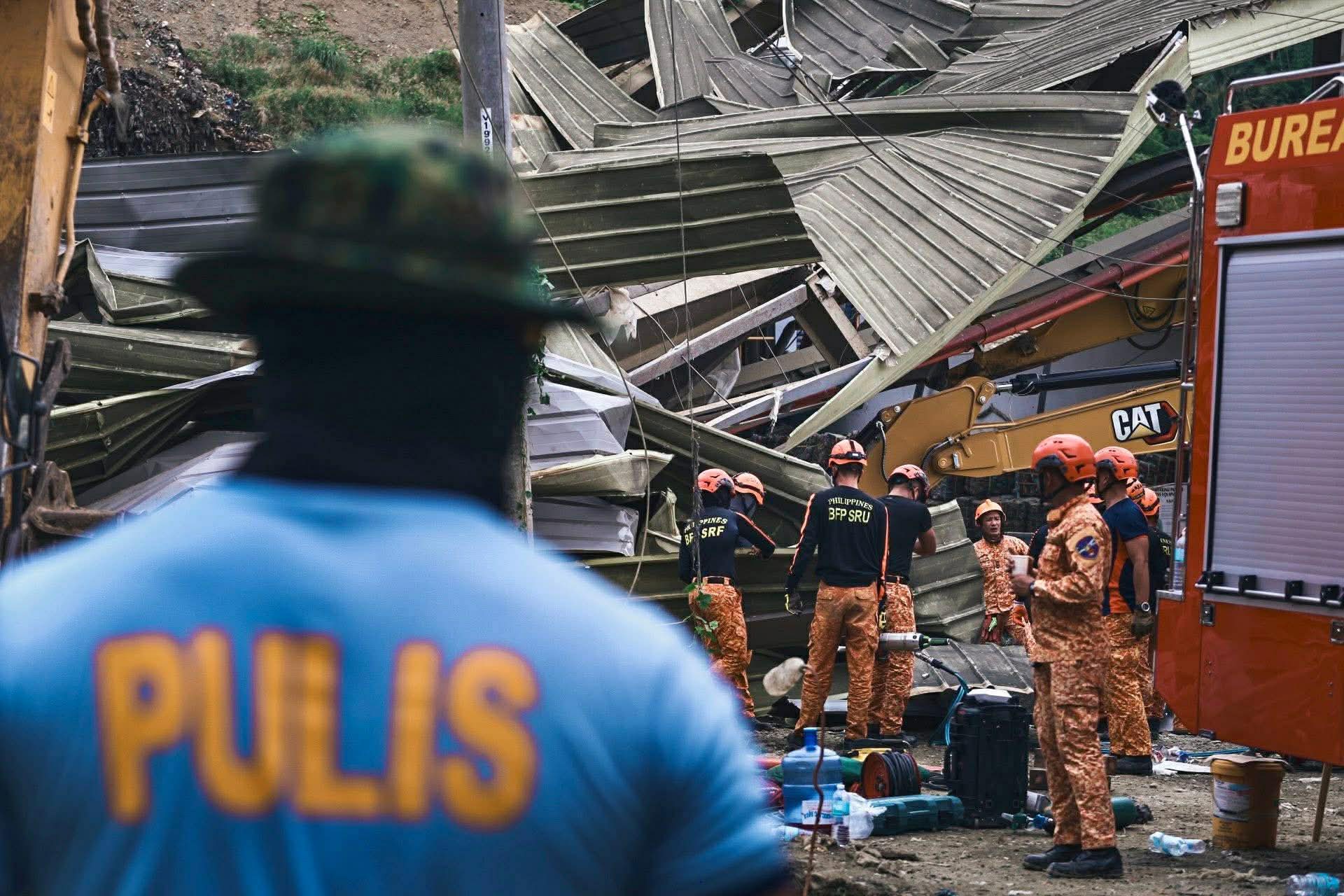
The stench of garbage and the threat of methane gas greet rescuers as they dig through the collapsed Binaliw landfill, where eight people have now died.
Cebu City Councilor Dave Tumulak, chairman of the Cebu City Disaster Risk Reduction and Management Council, said recovery teams retrieved eight bodies by 8:10 p.m. on Sunday, January 11, including two recent female victims.
Many others remain trapped under the massive mound of collapsed waste.
Tumulak reported that the Philippine Army deployed 38 personnel from the 525th Engineering Battalion of the Combat Engineer Regiment and 10 chemical, biological, radiological, and nuclear (CBRN) specialists from the Army’s Tarlac base.
These teams are working alongside local responders in the ongoing recovery operations.
Although city officials initially hoped to finish search and rescue quickly, Tumulak said the operation could extend beyond the week due to persistent hazards.
“Mayor Nestor Archival said awhile ago that the search and rescue will continue,” Tumulak told reporters on Sunday night, speaking in a mix of Cebuano and English.
Rescuers face multiple dangers at the site, including foul odors, methane gas trapped beneath the landfill, steel debris embedded in compacted waste, and continuous rainfall that destabilizes the area.
Tumulak said the garbage stench poses the first major health risk, followed by methane gas and steel debris that cannot be easily cut. Rainfall remains another major concern.
He also noted the psychological toll on responders, who regularly witness grieving families waiting for news of missing relatives.
“The emotional and psychological distress on responders is real, especially as they see families desperate to recover loved ones,” he said.
To limit health risks and prevent exhaustion, the city rotates responders in shifts, allowing them to work one hour on-site before resting.
Officials, together with Mayor Archival, continue to remind teams to prioritize safety while recovering bodies.
The collapse has disrupted Cebu City’s waste management system and forced officials to postpone some policy reforms.
On Sunday, January 11, Archival announced the city would defer full implementation of its “no segregation, no collection” policy, originally set for February 1.
Archival said the delay addresses immediate logistical and humanitarian needs following the collapse, which initially killed six, left 31 missing, and halted landfill operations.
The city also expects higher garbage volumes during the upcoming Sinulog 2026 festivities.
Despite the postponement, Archival emphasized that Cebu City remains committed to waste management reform.
The city collects about P100 million annually from garbage fees, far below its P550 million to P600 million yearly spending on waste services.
With much of the budget earmarked for social programs such as hospitalization, scholarships, senior citizen benefits, and health initiatives, officials view efficient waste management as critical to controlling costs.
Photo by Jacq Hernandez