



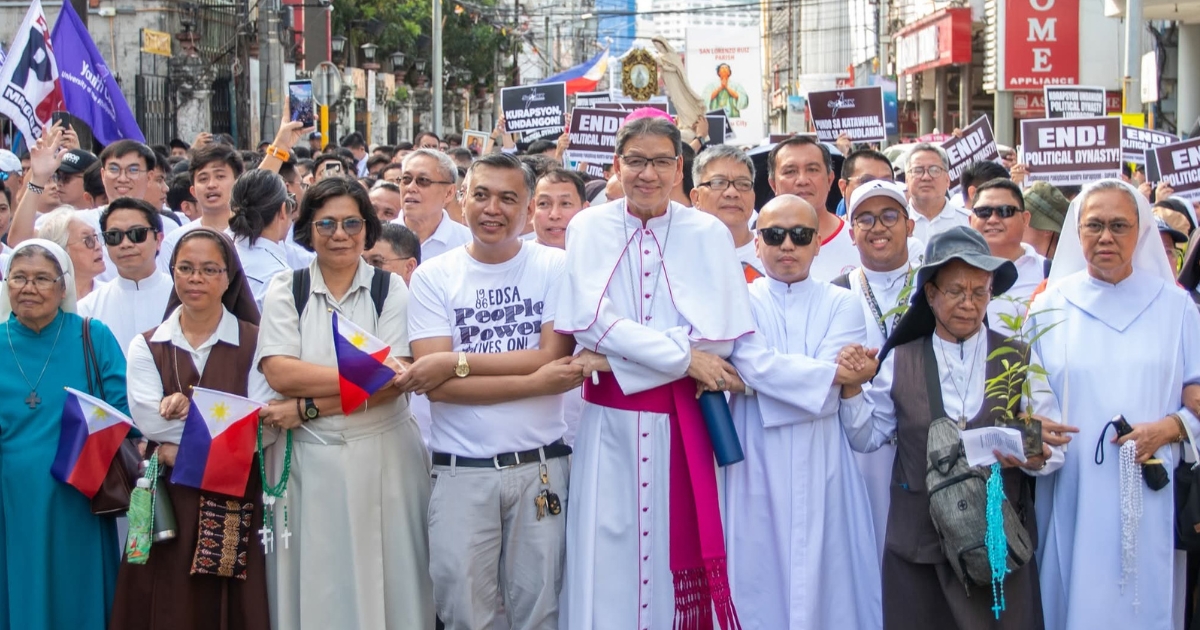
Forty years after millions of Filipinos gathered along Epifanio de los Santos Avenue in a peaceful uprising that toppled a dictatorship, downtown Cebu on Wednesday, February 25, echoed with the same language of faith, memory, and moral resolve.
From Freedom Park to Metro Colon in the morning, and from the Basilica Minore del Sto. Niño de Cebu to Plaza Independencia in the afternoon, Cebuanos commemorated the 40th anniversary of the 1986 EDSA People Power Revolution — not as distant history, but as a continuing call to remember the past, confront the present, and safeguard the future.
A morning of marching and memory
The day began with multi-sectoral groups marching from Freedom Park to Metro Colon. Students, civil society organizations, church groups, and private citizens joined the commemorative activity.
Participants carried banners and Philippine flags, many wearing shirts adorned with the iconic yellow ribbon — a symbol associated with the struggle against dictatorship and the restoration of democracy in 1986.
Speeches, chants, and performances highlighted themes of nonviolence, civic participation, and accountability in governance.
“Remembering EDSA is not just about nostalgia; it’s about applying the lessons of unity and courage in our everyday lives,” one organizer said.
At Metro Colon, participants formed a circle, clasped hands, and pledged to uphold human rights and protect democratic freedoms secured four decades ago.
Bells that tolled beyond ceremony
In the afternoon, the focus shifted to the Basilica, where hundreds gathered at the Pilgrim Center for a Eucharistic Celebration led by Cebu Archbishop Alberto Uy.
He was joined by Emmanuel Cabajar and members of the clergy.
Despite the heat, clergy, religious women, students, faculty members, church organizations, and lay faithful filled the venue. Many later joined a peace march toward Plaza Independencia.
At exactly 3 p.m., the Basilica’s bells tolled in solemn unison with parishes across the Archdiocese of Cebu.
The synchronized 40-second ringing symbolized four decades since the peaceful revolt that reshaped the nation’s political landscape.
Church leaders described the tolling not merely as ceremonial, but as a call to moral reflection.
In his homily, Archbishop Uy appealed to national leaders:
“To our leaders, I beg… Save your soul, save your family, save your humanity. Handle with conscience. Choose God, not the devil. Choose integrity, not wealth or power… Become good, brave and faithful stewards of the Filipino people.”
Switching to Cebuano, he urged the faithful to “pagsinggit pag-usab: Igo na sa pag-abuso sa gahum, igo na sa kahakog, igo na sa korapsyon” — enough of the abuse of power, greed, and corruption.
“Dili kini tawag sa kasuko o sa pagkabahin-bahin. Kini tawag sa konsensya. This is a call to moral conversion,” he said.
Peace march to Plaza Independencia
After the Mass and a short program reflecting on the revolution’s legacy, Archbishop Uy led a multi-sectoral peace march to Plaza Independencia.
Carrying flaglets and banners bearing messages of hope, truth, and accountability, participants described the activity as a public show of solidarity with SuPaKK 2.0 (Sugboanong Pakigbisog Kontra Korapsyon), a local movement advocating integrity and transparency.
Upon reaching Plaza Independencia, the archbishop offered flowers at the Martial Law marker in remembrance of the period marked by repression and human rights violations.
In a gesture reminiscent of the historic scenes in 1986, he also handed rosaries and flowers to personnel of the Armed Forces of the Philippines.
The commemoration concluded with the YUKBO Concert, where Cebuano artists presented musical tributes that capped a day defined by prayer, protest, and performance.
Beyond remembrance
The 40th anniversary of the EDSA People Power Revolution comes amid ongoing national conversations on governance, transparency, and civic engagement.
For many who gathered in Cebu City, the events were not simply about revisiting history, but about renewing its spirit.
The 1986 revolution was marked by prayerful resistance, civilian courage, and the assertion that power must answer to the people.
Forty years later, Cebuanos once again filled streets and church plazas to affirm that those principles endure.
Speakers reminded participants that the struggle for freedom and accountability did not end in 1986 — it continues in institutions, in communities, and in the daily choices of leaders and citizens alike. (LLP)
Photo from Roman Archdiocese of Cebu















Comments