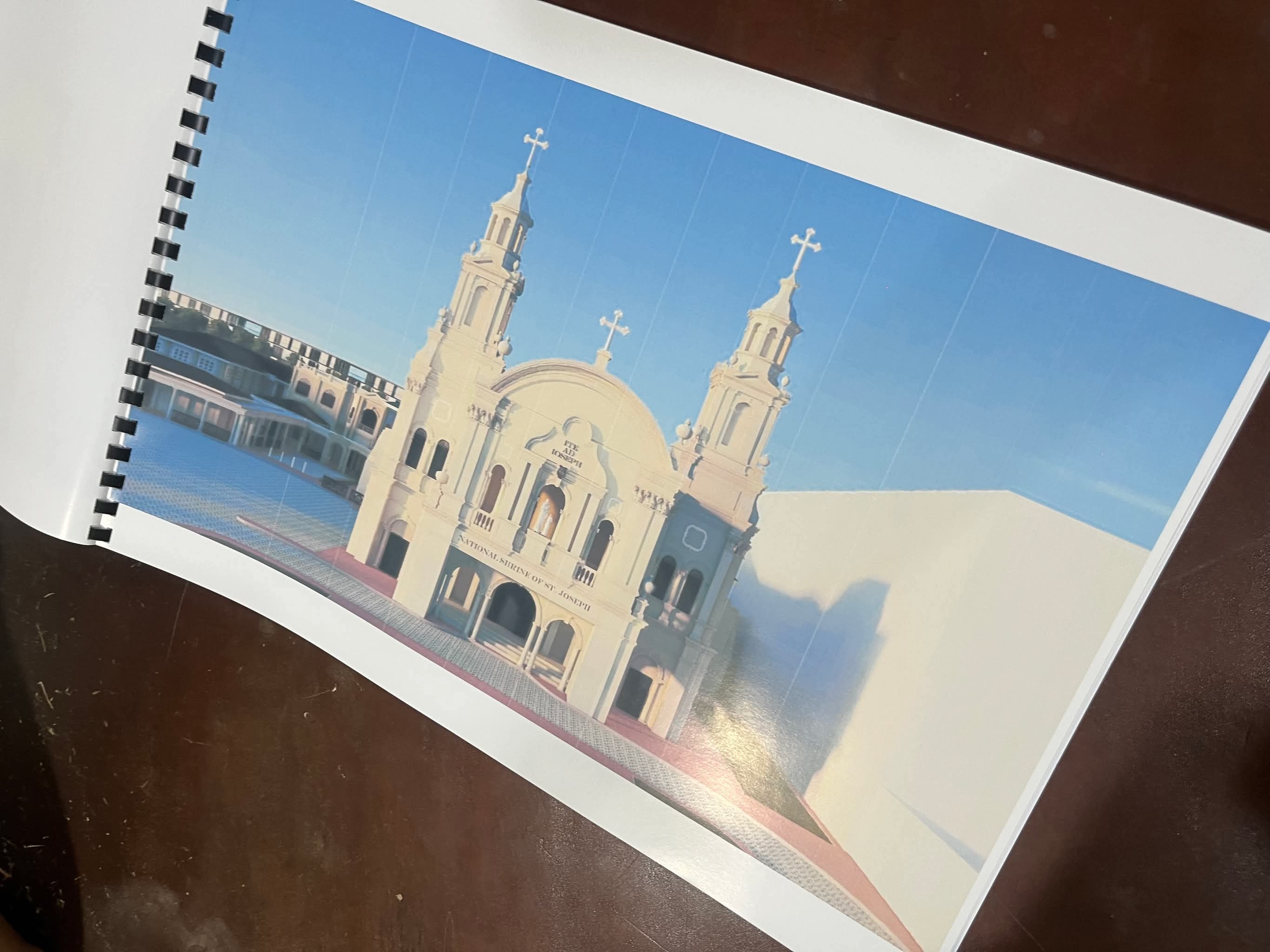
The National Shrine of St. Joseph unveiled a preliminary schematic plan for the church during a stakeholders’ meeting on Thursday, March 19, as part of ongoing efforts to attain basilica status.
Fr. Ian Fel Balankig, a member of the shrine’s Team of Pastors, together with Architect Roy John de Guzman of RDG Ecclesiastical Architecture, presented the latest developments of the project to attendees.
Fr. Balankig said the meeting aimed to foster a sense of ownership among stakeholders, noting that the construction cost is expected to exceed P100 million.
He encouraged families and donors to take ownership of specific components or contribute toward the project.
“God willing, we will construct this simultaneously, if they would commit. That is why we laid out all the plans for all the development, (kahit) iba iba ang contractor but just follow this plan so that pasok tayo sa timeline,” Fr. Balankig said.
He added that project coordinator Abet Uy hopes to submit the basilica application to Rome in less than six years, with the required documents targeted for 2029.
De Guzman said the church’s current interior design will be retained while extending the turn-of-the-century style to exterior facilities, drawing inspiration from Neoclassicism and the American period.
The architect revealed that in November 2025, the team began assessing the church’s structural and electrical condition to determine further needs.
He emphasized that the design remains preliminary and will be finalized after ongoing consultations with stakeholders.
“It is not yet the final design, but we have to have synodality with the stakeholders first. Again, the church is for the people,” De Guzman said.
Based on the schematic plan, the team intends to improve and extend the church façade, reorganize entrances and exits for better traffic flow, and provide adequate space for pilgrimage activities and bus parking.
During major celebrations, including Lenten observances, up to three or four pilgrim buses may arrive simultaneously, highlighting the need for wider open areas.
The plan also includes enhancements to the candle area to promote reverence, as well as additional facilities such as comfort rooms, a security area, a coffee shop, a gift shop, and what is envisioned to be the largest museum in the country dedicated to St. Joseph.
These facilities are expected to generate income and support the basilica’s long-term sustainability.
“It is also part of the experience na ang pilgrims after nila og visit sa church, they go to the museum and buy some mementos and tokens at the gift shop, and while waiting for the rest nga naa sa simbahan, they can visit the coffee shop,” Fr. Balankig said.
Other criteria for basilica status include the church’s history and the depth of devotion to its patron saint.
Fr. Balankig also stressed the importance of local government support, noting that achieving basilica status can bring economic benefits to the city.
De Guzman cited the Diocesan Shrine and Parish of St. Paul of the Cross as a case study, noting that it was completed in 2018 and elevated to a basilica in 2023 due to its complete facilities.
He said the team is following a similar approach, analyzing crowd volume during major religious events in Mandaue City to guide design decisions.
“The architecture, hindi siya nagsisimula sa building, nagsisimula siya saan nanggaling ang mga users, ang mga pilgrims,” De Guzman said.
The shrine first applied for basilica status in 2019, with a formal letter of intention sent to Rome in 2023.
The current development plans are part of the requirements needed to achieve its goal of becoming a basilica. (VCL)