



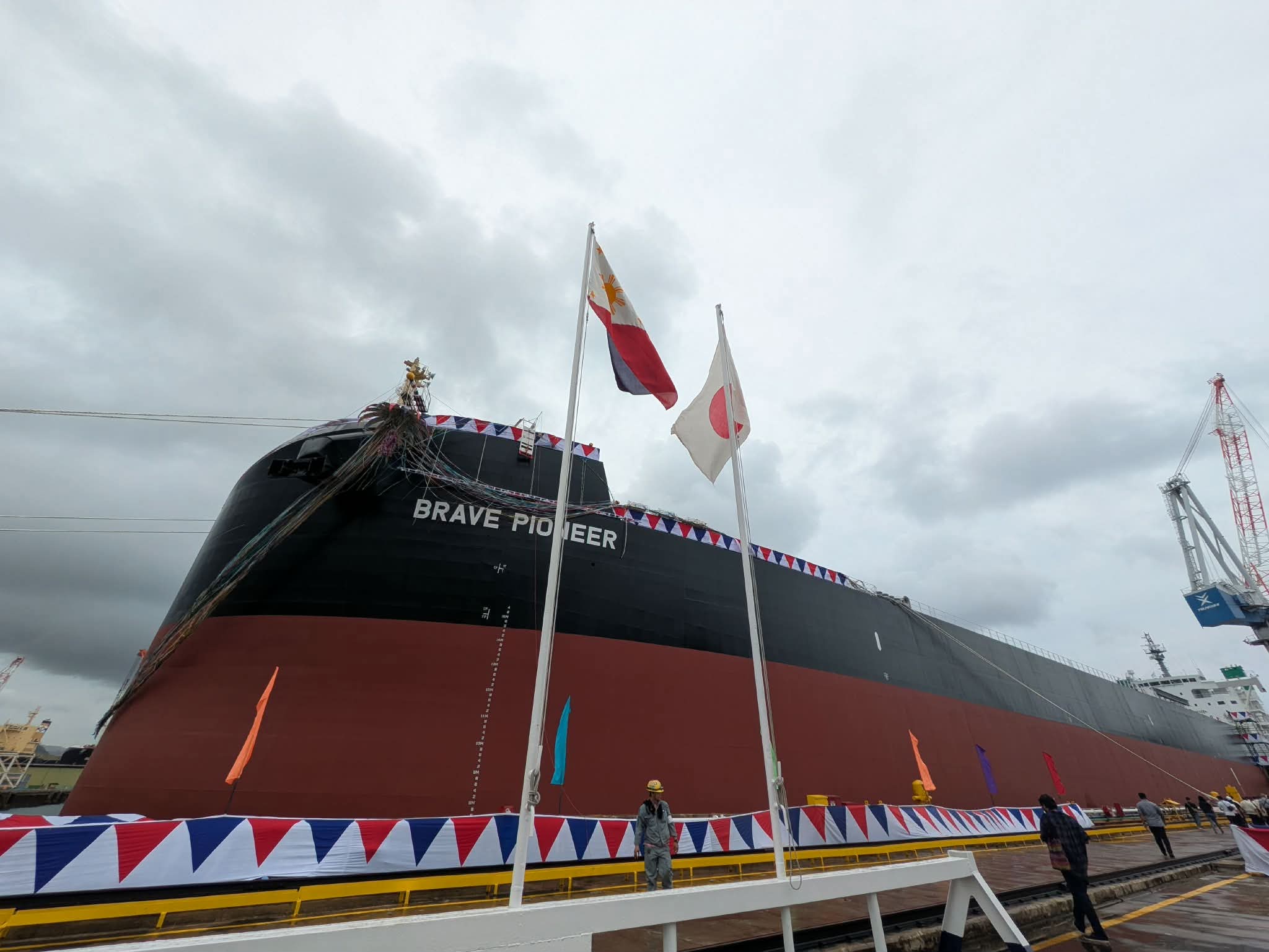
Rain fell over Balamban, Cebu on January 15 as the world’s first methanol dual-fuelled KAMSARMAX bulk carrier was officially named and delivered at the West Cebu Estate Special Economic Zone.
President Ferdinand “Bongbong” Marcos Jr. christened the vessel Brave Pioneer, describing the milestone as a signal that the Philippines is ready to compete in a global shipping industry shifting toward low-emission technology.
“This sends a clear message to the world that the Philippines is ready to lead in the transition toward sustainable shipping,” Marcos said during the ceremony.
The vessel, identified as Hull No. SC443, was built by Tsuneishi Heavy Industries (Cebu), Inc. (THI), the Philippine arm of Japan-based Tsuneishi Shipbuilding Co., Ltd., in partnership with the Aboitiz Group.
Marcos said the delivery represented more than a single ship, calling it a reflection of “progress, innovation, and Filipino capability” as global maritime regulations tighten.
“Today, as we witness the delivery of the world’s first methanol dual-fuelled KAMSARMAX bulk carrier, we mark a historic milestone for Philippine shipbuilding,” he said.
Designed to run on methanol, Brave Pioneer is expected to cut carbon dioxide emissions by about 10 percent, nitrogen oxides by 80 percent, and sulfur oxides by 99 percent compared with conventional vessels.
In a statement, Aboitiz Group Inc. said the use of methanol—particularly green methanol—aligns the vessel with International Maritime Organization decarbonization targets and emerging global standards.
Measuring 229 meters long, the KAMSARMAX-type bulk carrier is designed with a shallow and low air draft, allowing it to operate in a wide range of ports worldwide, including Kamsar Port in Guinea.
Marcos said shipyards capable of building low-emission vessels stand to benefit from growing global demand for greener shipping solutions.
“Philippine shipyards that can deliver these vessels gain access to premium international markets,” he said.
He also pointed to the broader economic impact of green shipbuilding, citing opportunities for sustainability-linked financing and growth in related industries such as marine components and energy-efficient systems.
As of November 2025, the Philippines has more than 130 registered shipyards employing over 11,000 workers, about 70 percent of whom are skilled professionals, based on figures cited by the President.
In 2024, local shipyards built 484 vessels of various types, ranging from fishing boats to passenger and cargo ships, reflecting continued growth in the sector.
Aboitiz Group President and CEO Sabin M. Aboitiz said the delivery underscored Balamban’s transformation over the past three decades from a fishing town into what he described as the country’s shipbuilding hub.
“Standing here today, looking at this massive ship behind me, it’s hard not to feel a little small, but also deeply proud,” Aboitiz said.
He said the partnership with Tsuneishi has generated around 12,000 jobs and delivered more than 380 vessels globally, all built by Filipino workers.
Tsuneishi Shipbuilding President and CEO Okumura Sachio said the delivery of Brave Pioneer capped years of ship design and engineering within the Tsuneishi Group.
“We are extremely proud to have completed and delivered the world’s first methanol dual-fuelled KAMSARMAX bulk carrier at THI,” Okumura said. (SBA)















Comments