
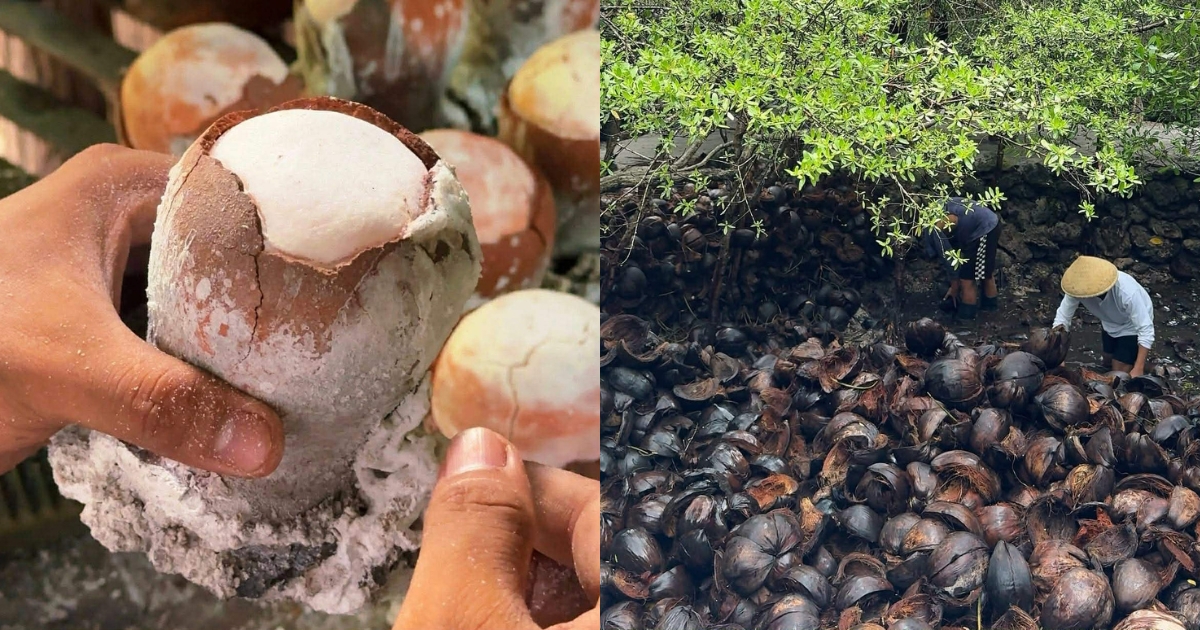
A recent feature by content creator Joseph the Explorer has renewed interest in one of the Philippines’ most extraordinary culinary treasures, Asin Tibuok, a centuries old artisanal salt tradition preserved in the quiet coastal town of Alburquerque.
Often referred to as the “Dinosaur Egg” because of its hard, oval shape, Asin Tibuok is widely regarded as one of the rarest salts in the world. The traditional method of producing it dates back more than 400 years, surviving Spanish colonization, industrialization, and the rise of mass produced table salt. Today, however, it is made by only a handful of families, placing the practice at risk of disappearing entirely. It has been recognized by UNESCO as a heritage food tradition at risk of extinction.
A Six Month Labor of Tradition
What sets Asin Tibuok apart is not only its rarity, but the painstaking process behind each piece.
Production begins with coconut husks soaked in seawater for several months. Once saturated with minerals, the husks are dried and burned into ash. This ash, rich in natural salts and trace minerals, is then carefully filtered with more seawater to produce a highly concentrated brine.
The brine is poured into specially crafted clay pots and boiled continuously for eight to ten hours over an open flame. As the liquid evaporates, salt crystals gradually solidify inside the pot, forming a dense, stone like sphere. When the clay mold is broken open, what remains is a solid orb of salt, heavy, rustic, and deeply symbolic of Bohol’s coastal heritage.
From start to finish, a single sphere can take more than six months to produce.
Flavor and Function
Beyond its striking appearance, Asin Tibuok is prized for its complex flavor profile. Unlike refined table salt, it carries a subtle smokiness from the coconut husk ash, balanced by a slightly sweet and mineral rich finish. Chefs often grate it over dishes just before serving. When shaved, it falls like fine snow, delivering a delicate yet nuanced salinity that enhances rather than overpowers food.
Its uniqueness has attracted the attention of culinary enthusiasts, heritage advocates, and chefs both locally and internationally.
A Heritage Worth Preserving
Despite growing recognition, the future of Asin Tibuok remains uncertain. The labor intensive process, limited producers, and competition from inexpensive commercial salt make it difficult to sustain. Preserving Asin Tibuok is not merely about saving a seasoning, it is about safeguarding a living tradition that reflects the ingenuity and cultural identity of coastal Boholanos.
As renewed interest emerges through digital storytelling and culinary advocacy, there is hope that greater awareness will translate into stronger support for the families who continue to keep this centuries old craft alive.
In every solid sphere of Asin Tibuok lies more than salt, it holds history, resilience, and the enduring taste of Philippine heritage.
Photo by Chef Joseph