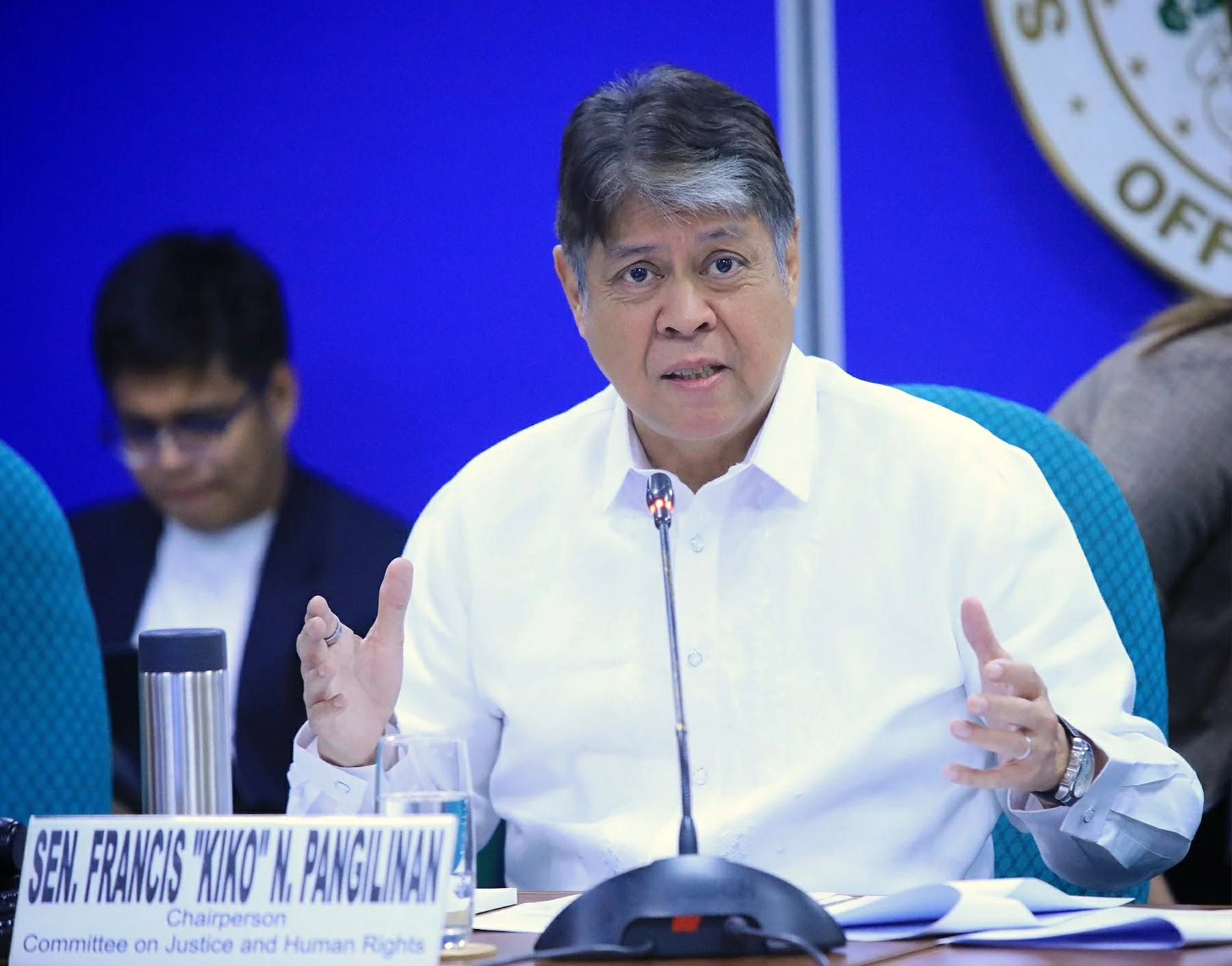
Senator Francis “Kiko” Pangilinan emphasized the urgent need to pass Senate Bill No. 1547, which proposes the creation of a Joint Congressional Commission on Justice Reform, during the Committee on Justice and Human Rights hearing on Wednesday, March 11, 2026.
The senator pointed to the slow pace of the Philippine justice system, citing the 2004 Fertilizer Scam as a stark example.
He noted that the case took 21 years to reach a conviction in the Sandiganbayan, highlighting how prolonged proceedings can delay accountability and justice for citizens.
“This delay shows how necessary it is to examine our justice processes carefully and find ways to make them more effective,” Pangilinan said during the session.
Pangilinan also drew attention to international assessments of the country’s rule of law.
He cited the 2025 World Justice Project Rule of Law Index, which ranked the Philippines 97th out of 143 countries worldwide and 13th out of 15 in East Asia and the Pacific.
The ranking revealed especially weak scores in civil and criminal justice, underscoring gaps in the country’s ability to deliver timely and fair outcomes.
Against this backdrop, Pangilinan said the proposed Joint Congressional Commission on Justice Reform could serve as a platform to identify weaknesses and recommend solutions.
“We believe that a Joint Congressional Commission on Justice Reform is necessary. A commission that listens to data and the voice of the people, that studies our courts, prosecutors, jails, and police — not to point fingers, but to fix what is broken,” Pangilinan said.
The measure seeks to provide a mechanism for lawmakers to systematically study the justice system, including courts, prosecutors, detention facilities, and law enforcement, without focusing on individual blame.
The commission is intended to gather input from both statistical data and public feedback to ensure reforms are responsive to the needs of citizens.
By establishing a formal body dedicated to justice reform, Pangilinan said lawmakers can better identify structural problems in criminal and civil procedures and propose solutions aimed at efficiency, transparency, and fairness.
The hearing on March 11 served as a venue to discuss the bill’s objectives, review supporting data, and highlight the pressing need to modernize and streamline the Philippine justice system for the benefit of the public.
Photo from Senate of the Philippines